
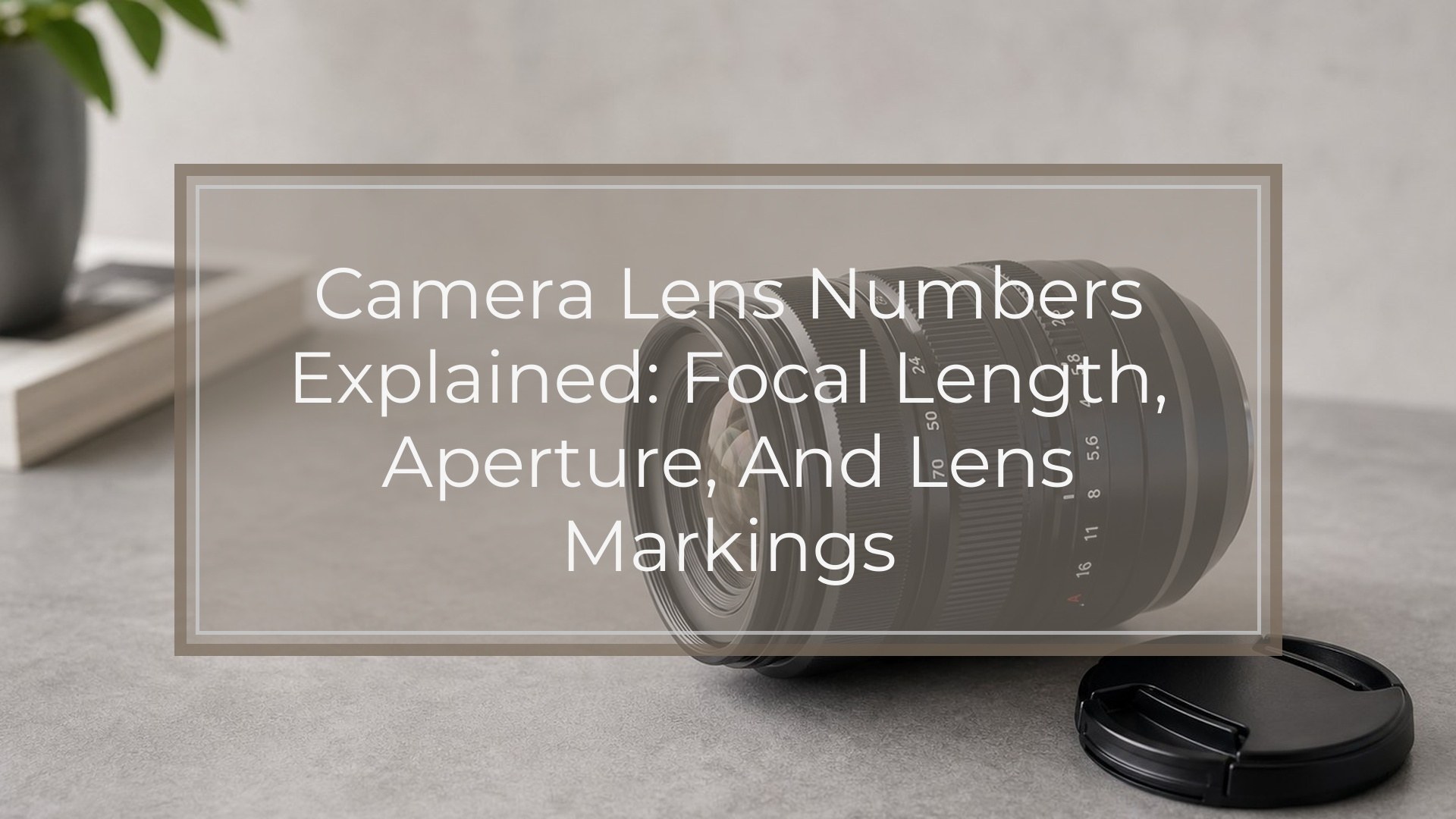
Camera lens numbers tell you what a lens can see, how much light it can let in, what accessories fit it, and how close it can focus. The most important number is usually the focal length, written in millimeters, such as 35mm or 18-55mm. This affects how wide or zoomed-in the view looks. The next major number is the aperture, written as f/1.8, f/2.8, or f/3.5-5.6. This affects low-light ability and background blur. Other numbers may show filter size, minimum focus distance, magnification, or lens diameter. Once you understand these labels, lens names become much less intimidating.
What the Numbers on a Camera Lens Are Telling You
Think of camera lens numbers as a quick specification label, not a secret code. They answer practical questions: How much of the scene will fit in the frame? How bright is the lens? Can it blur the background easily? Will your filters or lens cap fit? Can it focus close enough for small subjects?
Here is the basic mental model:
| Lens marking | What it usually tells you |
|---|---|
| 18mm, 35mm, 200mm | Field of view and apparent zoom |
| f/1.8, f/2.8, f/4 | Maximum light-gathering ability |
| f/3.5-5.6 | Variable maximum aperture on a zoom |
| Ø58mm | Filter and lens cap size |
| 0.25m / 0.8ft | Closest focusing distance |
| 1:1, 1:2, 0.25x | Magnification or macro ability |
Start with focal length and aperture. Those two numbers explain most of how a lens behaves.
Focal Length: the Millimeter Number
The millimeter number, such as 24mm, 50mm, or 70-200mm, is the focal length. For beginners, the easiest way to understand focal length is this: smaller numbers show a wider view, and larger numbers show a narrower, more zoomed-in view.
A 16mm or 18mm lens is wide-angle. It fits more of the scene into the photo, which is useful for landscapes, interiors, travel, and vlogging. A 35mm or 50mm lens gives a more natural-looking view and is common for everyday photography, portraits, and street photos. A 100mm, 200mm, or 300mm lens brings distant subjects closer, which helps with sports, wildlife, events, and compressed portrait backgrounds.
If a lens has one number, like 50mm, it is a prime lens. It does not zoom. If it has a range, like 18-55mm or 70-200mm, it is a zoom lens. The lens can move between those focal lengths.
Focal length does not change your physical distance from the subject, but it changes how much of the scene appears in the frame and how large subjects look.
Aperture Numbers: What F/1.8, F/2.8, and F/3.5-5.6 Mean
Aperture numbers are written with an “f,” such as f/1.8, f/2.8, f/4, or f/5.6. On a lens label, this number usually shows the maximum aperture, meaning the widest opening the lens can use.
A lower f-number means the lens can open wider. That lets in more light and can create stronger background blur. For example, an f/1.8 lens is considered bright and useful for portraits, indoor photos, and low light. An f/2.8 lens is also bright and is common on higher-end zoom lenses. An f/4 or f/5.6 lens lets in less light at its widest setting, but may still be perfectly good in daylight or with image stabilization.
Some lenses have one maximum aperture number, such as 50mm f/1.8 or 24-70mm f/2.8. This means the maximum aperture stays the same throughout the focal length range.
Other lenses show a range, such as f/3.5-5.6. This is a variable maximum aperture. On an 18-55mm f/3.5-5.6 lens, the lens can open to f/3.5 at 18mm, but only to f/5.6 when zoomed to 55mm. That is normal on many affordable kit lenses.
What 18-55mm F/3.5-5.6 Means as a Full Lens Label
Now combine the two main numbers. An 18-55mm f/3.5-5.6 lens is a zoom lens with a focal length range from 18mm to 55mm. At 18mm, it gives a wider view, good for group photos, travel scenes, and indoor spaces. At 55mm, it gives a tighter view, useful for portraits, details, and general everyday subjects.
The f/3.5-5.6 part tells you the widest aperture changes as you zoom. At 18mm, the widest available aperture is f/3.5. At 55mm, the widest available aperture is f/5.6. You can still choose smaller apertures like f/8 or f/11, but you cannot open wider than the listed maximum.
This label tells you the lens is flexible, beginner-friendly, and compact, but not especially bright compared with f/1.8 or f/2.8 lenses.
Filter Size: the Ø Number on the Front of the Lens
The Ø symbol marks the filter thread diameter. You may see something like Ø52mm, Ø58mm, Ø67mm, or Ø77mm printed on the front rim of the lens. This is not the focal length. It tells you what size screw-in filters and lens caps fit the front of the lens.
For example, if your lens says Ø58mm, you need a 58mm UV filter, polarizing filter, neutral density filter, or replacement lens cap. A 67mm filter will be too large, and a 52mm filter will be too small.
This number matters when buying accessories. If several lenses use the same filter size, you can share filters between them. If not, step-up rings can sometimes adapt larger filters to smaller lenses.
Minimum Focus Distance and Magnification Numbers
Some lenses list a minimum focus distance, such as 0.25m/0.8ft or 1.2m/3.9ft. This tells you the closest distance at which the lens can focus. It is usually measured from the camera sensor, not from the front of the lens, so the actual working distance may feel shorter than the number suggests.
Close-focus ability matters for flowers, food, products, small details, and tabletop photography. A lens with a shorter minimum focus distance can focus closer, but that does not automatically make it a true macro lens.
Magnification numbers explain how large the subject can appear on the sensor. A true macro lens often says 1:1 or 1.0x, meaning life-size reproduction. A 1:2 or 0.5x lens gives half life-size magnification. For casual close-ups, you do not always need 1:1, but it is important for serious macro work.
Crop Factor: Why the Same Lens Number Can Look Different on Different Cameras
A 50mm lens is always a 50mm lens, but it may not look the same on every camera. Sensor size affects field of view. A full-frame camera uses the traditional reference point. A crop-sensor camera captures a smaller portion of the image circle, making the view look tighter.
For example, a 50mm lens on many APS-C cameras gives a field of view similar to about 75mm or 80mm on full frame, depending on the brand. On Micro Four Thirds, it looks like about 100mm full-frame equivalent.
This does not mean the lens physically zooms in or changes focal length. It means the camera sensor crops the view. When comparing lenses, beginners should look for the full-frame equivalent field of view if they use different sensor formats. This is especially helpful when choosing wide-angle lenses, because crop sensors make wide lenses look less wide.
Other Lens Markings You May See
Lens names often include letters and abbreviations along with the numbers. These vary by brand, but they usually describe compatibility, stabilization, focusing motors, lens quality, or special glass.
For example, Canon uses labels such as EF, EF-S, RF, and IS. Nikon uses terms like Z, DX, FX, and VR. Sony uses FE, E, OSS, and GM. Sigma, Tamron, and other brands have their own codes too.
You do not need to memorize every label at first. Focus on three questions: Does the lens fit your camera mount? Does it cover your sensor size? Does it include features you need, such as image stabilization or weather sealing?
Also watch for “macro,” “III,” “II,” or “Mark II” labels. These may indicate close-focus design or a newer version of an older lens.
How to Read Lens Numbers Before You Buy
Before buying a lens, read the numbers in a simple order.
First, check the mount and sensor compatibility. A lens can have perfect numbers and still be wrong for your camera if it does not fit or does not cover your sensor properly.
Second, look at focal length. Ask what you want to photograph. Wide numbers like 16-24mm suit landscapes and interiors. Mid-range numbers like 35-85mm work well for everyday photos and portraits. Longer numbers like 100-400mm help with distant subjects.
Third, check the maximum aperture. If you shoot indoors, portraits, weddings, concerts, or low light, f/1.8 or f/2.8 can be valuable. If you mostly shoot travel and daylight scenes, a smaller variable-aperture zoom may be enough.
Fourth, note filter size, minimum focus distance, stabilization, and weight. These details affect everyday use. The best lens is not always the one with the biggest zoom range or lowest f-number; it is the one whose numbers match your subject, camera, and budget.
FAQ
What Should a Beginner Know First About Camera Lens Numbers?
Start with focal length and aperture. Focal length, written in millimeters, tells you how wide or zoomed-in the view looks. Aperture, written as an f-number, tells you how much light the lens can gather and how easily it can blur backgrounds.
What Matters Most When Evaluating Camera Lens Numbers?
The most important numbers depend on what you shoot. For general use, focal length range and maximum aperture matter most. For accessories, check filter size. For close-ups, check minimum focus distance and magnification. Also confirm the lens fits your camera mount and sensor size.
What Mistakes Should Readers Avoid with Camera Lens Numbers?
Do not confuse focal length with filter size. A 50mm lens and a Ø50mm filter thread mean different things. Also avoid assuming bigger zoom is always better, or that a low f-number matters for every photographer. Match the numbers to your actual shooting needs.
What Is the Next Logical Step After Learning About Camera Lens Numbers?
Look at the lens you already own and decode every number on it. Then compare it with one lens you are considering buying. Notice the differences in focal length, aperture, filter size, close focus, stabilization, and compatibility before deciding whether it solves a real problem.