
A fast lens is a camera lens with a large maximum aperture, usually something like f/1.2, f/1.4, f/1.8, f/2, or f/2.8. “Fast” means the lens lets in more light, so your camera can use a faster shutter speed in the same lighting conditions.
For beginners, the main reasons to get a fast lens are better low-light photos, more background blur, and easier shooting indoors without pushing ISO too high. A fast lens is especially useful for portraits, events, street photography, pets, kids, and indoor scenes.
You do not need one for every type of photography. But if your kit lens feels limiting in dim light or you want stronger subject separation, a fast lens is one of the most noticeable upgrades you can buy.
What Does “Fast Lens” Mean?
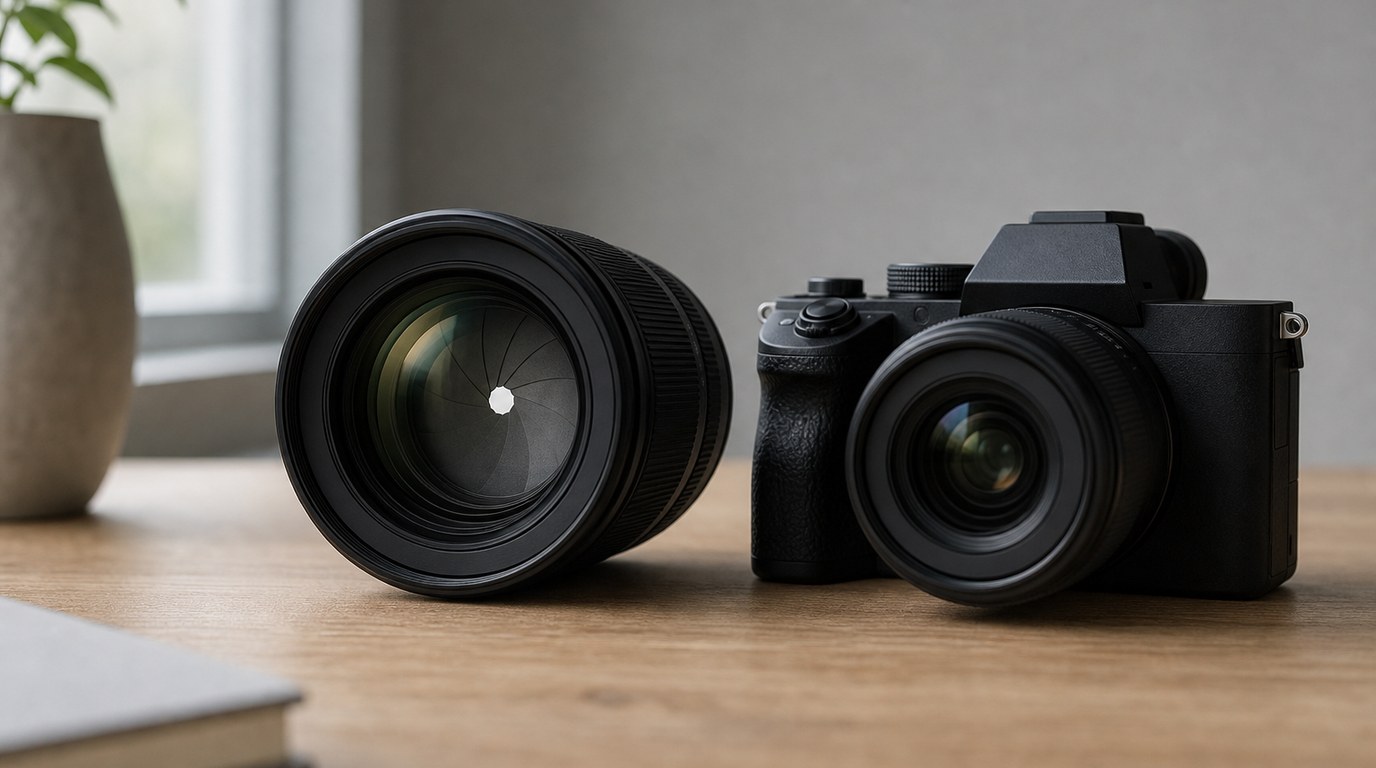
A “fast lens” is a lens with a wide maximum aperture. The aperture is the adjustable opening inside the lens that controls how much light reaches the camera sensor.
The term “fast” comes from shutter speed. Because the lens lets in more light, you can use a faster shutter speed and still get a properly exposed photo. That helps freeze motion and reduce blur from camera shake.
For example, a 50mm f/1.8 lens is usually considered fast. A basic kit zoom with a maximum aperture of f/3.5-5.6 is not usually called fast, especially at the zoomed-in end. The important number is the lens’s widest available f-number.
The Simple Aperture Mental Model
Aperture numbers can feel backward at first: smaller f-numbers mean a larger opening. So f/1.8 lets in more light than f/4, even though 1.8 is the smaller number.
A good mental model is to imagine a window. A large window lets in more light than a small window. In lens terms, f/1.8 is the larger window, while f/5.6 is the smaller window.
Each major step in aperture, called a stop, roughly doubles or halves the amount of light. For example, f/2.8 lets in twice as much light as f/4. That extra light gives your camera more flexibility: it can use a faster shutter speed, a lower ISO, or both.
A wide aperture also creates shallower depth of field. That means less of the scene appears sharp from front to back, which is why fast lenses can create creamy background blur.
Common Fast Lens Apertures Compared
Different lenses have different maximum apertures. A lower maximum f-number usually means the lens is faster, better in low light, and better at blurring backgrounds. It may also cost more or be larger.
Here is a beginner-friendly comparison:
| Maximum aperture | Usually considered fast? | What it is good for |
|---|---|---|
| — | —: | — |
| f/1.2 | Very fast | Low light, portraits, very shallow background blur |
| f/1.4 | Very fast | Portraits, weddings, indoor available-light photography |
| f/1.8 | Fast | Affordable portraits, low light, beginner prime lenses |
| f/2 | Fast | Compact primes, street, travel, indoor scenes |
| f/2.8 | Fast for zooms | Events, sports, weddings, versatile low-light zooms |
| f/3.5-5.6 | Usually not fast | General daylight photography, kit zoom use |
| f/4 | Moderate | Travel zooms, landscapes, outdoor general use |
Aperture is not the only thing that matters, but it is the main reason a lens earns the “fast” label.
Why Should You Get a Fast Lens?
The biggest practical benefit is better performance in low light. Indoors, at night, or in shaded areas, a slow lens may force your camera to use a high ISO or a slow shutter speed. A fast lens gives you more light to work with, which can mean cleaner images and less motion blur.
Fast lenses also make it easier to blur the background. This is useful for portraits, product photos, food photography, and any scene where you want the subject to stand out. A photo of a person against a busy street can look much cleaner at f/1.8 than at f/5.6.
Another benefit is creative control. With a fast lens, you can choose whether to shoot wide open for a soft background or stop down to f/4 or f/5.6 for more sharpness and depth. A slower lens simply cannot open as wide, so you have fewer options.
When a Fast Lens Makes the Biggest Difference
A fast lens helps most when light is limited or your subject is moving. Examples include indoor family photos, birthday parties, concerts, restaurants, museums, evening street photography, and pets or children moving around the house.
It also matters when flash is not allowed or would ruin the mood. A fast lens lets you keep more of the natural light in the scene.
For portraits, a fast lens can make a dramatic difference even in good light because of the shallow depth of field. A simple 50mm f/1.8 can turn a cluttered background into a soft blur.
The difference is smaller for landscapes, studio flash photography, real estate, or tripod-based work, where you often use narrower apertures anyway.
The Trade-offs: Why Fast Lenses Are Not Always Better
Fast lenses are useful, but they are not automatically the best choice. The first trade-off is price. An f/1.4 lens usually costs more than an f/1.8 version, and a professional f/2.8 zoom can be much more expensive than a basic kit zoom.
Size and weight can also increase, especially with fast zooms and full-frame lenses. A lens that looks perfect on paper may be annoying to carry all day.
There is also a focusing challenge. At very wide apertures, depth of field becomes thin. If you photograph a person at f/1.4, one eye might be sharp while the other is slightly soft if focus is not precise.
Finally, lenses are not always sharpest wide open. Many improve when stopped down a little. A fast lens gives you the option to shoot wide open, but you do not have to use the widest aperture all the time.
Fast Prime Vs Fast Zoom: Which Should Beginners Consider?
A fast prime lens has one fixed focal length, such as 35mm f/1.8 or 50mm f/1.8. It does not zoom, but it is often smaller, lighter, sharper, and cheaper than a fast zoom. For many beginners, a fast prime is the best first upgrade.
A fast zoom, such as a 24-70mm f/2.8 or 70-200mm f/2.8, is more flexible because it covers multiple focal lengths. This is helpful for weddings, events, sports, and paid work where you cannot always move closer or farther away.
If you are learning, start with an affordable f/1.8 prime that matches what you shoot. If you need flexibility more than maximum blur, consider a constant f/2.8 zoom.
How to Decide If You Actually Need One

Ask yourself what problem you are trying to solve. If your photos are blurry indoors, noisy in low light, or too busy in the background, a fast lens may help.
Check your current lens first. If it says something like 18-55mm f/3.5-5.6, it becomes relatively slow when zoomed in. Upgrading to a 35mm f/1.8, 50mm f/1.8, or f/2.8 zoom could make a visible difference.
You may not need a fast lens if you mostly shoot landscapes on a tripod, travel in daylight, or use flash in controlled settings. Buy for your actual shooting habits, not just the lowest f-number.
Bottom Line
A fast lens is a lens with a wide maximum aperture that lets in more light. It can help you use faster shutter speeds, lower ISO settings, and blurrier backgrounds.
You should consider getting one if you often shoot indoors, in low light, or want stronger subject separation. For most beginners, an affordable f/1.8 prime is the easiest way to experience what a fast lens can do without spending too much.
FAQ
What Should a Beginner Know First About What Is a Fast Lens and Why Should I Get One?
A beginner should know that “fast” refers to a lens’s wide maximum aperture, not autofocus speed. A fast lens lets in more light, which helps in low light and allows more background blur. Common beginner-friendly fast lenses include 35mm f/1.8 and 50mm f/1.8 primes.
What Matters Most When Evaluating What Is a Fast Lens and Why Should I Get One?
The most important factor is whether the lens solves a real problem for your photography. Look at maximum aperture, focal length, price, size, and compatibility with your camera. A fast lens is valuable when it matches your subjects, not just because it has a low f-number.
What Mistakes Should Readers Avoid with What Is a Fast Lens and Why Should I Get One?
Avoid assuming the widest aperture is always best. Shooting at f/1.4 or f/1.8 can make focusing harder and may leave too little in focus. Also avoid buying an expensive fast zoom if a simple, affordable prime would solve your low-light or portrait needs.
What Is the Next Logical Step After Learning About What Is a Fast Lens and Why Should I Get One?
Check the maximum aperture printed on your current lens, then compare it with lenses available for your camera mount. If you want an easy upgrade, research a 35mm f/1.8 or 50mm f/1.8 lens and see which focal length fits your everyday shooting style.