
Crop factor is a way to compare how much of a scene different camera sensor sizes capture with the same lens. The main takeaway is simple: crop factor does not change a lens’s actual focal length, but it does change the field of view you get on that camera. A 50mm lens is always a 50mm lens, yet it looks tighter on an APS-C or Micro Four Thirds camera than it does on full frame.
For beginners, crop factor matters most when choosing lenses, comparing cameras, and understanding “full-frame equivalent” numbers. If you remember one idea, make it this: crop factor is mainly about framing and lens choice, not magic extra zoom.
Quick Answer
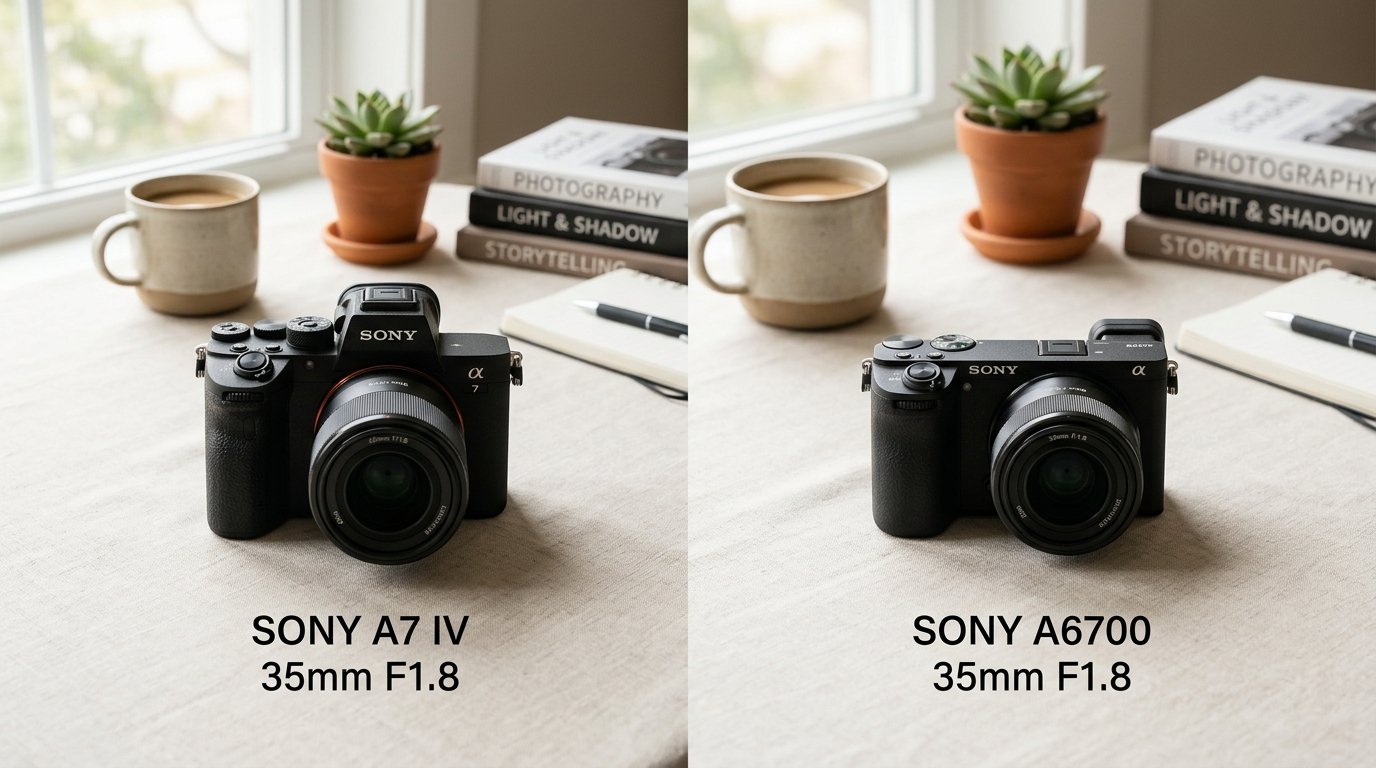
Crop factor compares a smaller sensor to full frame, which is treated as the reference format. Full frame has a crop factor of 1.0x. Many APS-C cameras are about 1.5x or 1.6x, and Micro Four Thirds is 2.0x.
What does that mean in practice? If you mount the same lens on different sensor sizes and stand in the same place, the smaller sensor captures a narrower part of the image circle. The photo looks more “zoomed in,” even though the lens itself has not changed.
A quick example makes this easier:
- 50mm on full frame = normal 50mm view
- 50mm on 1.5x APS-C = similar framing to 75mm on full frame
- 50mm on 2x Micro Four Thirds = similar framing to 100mm on full frame
The basic formula is:
Equivalent focal length = actual focal length × crop factor
So why should you care? Because crop factor helps you predict whether a lens will feel wide, normal, or telephoto on your camera. It is especially useful when reading lens recommendations, shopping for your first lenses, or switching between camera systems.
How to Think About This Topic
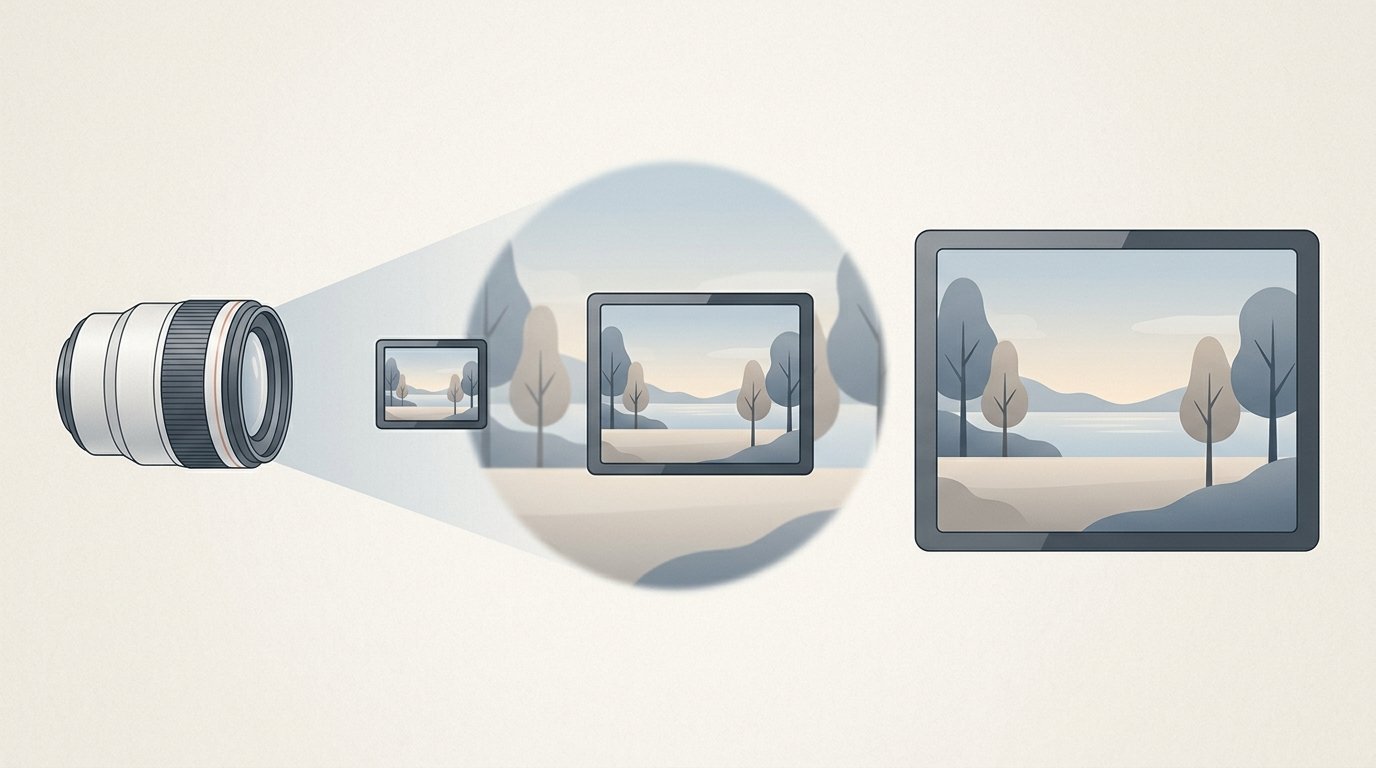
The easiest mental model is to imagine that a lens projects a large circular image, and the sensor records only part of it. A bigger sensor records more of that image circle. A smaller sensor records less, so the scene appears tighter.
That is why crop factor is really about field of view. It tells you how much the framing changes compared with full frame. If you have ever heard someone say, “My 35mm lens feels like a 50mm on APS-C,” they are talking about equivalent field of view, not a physical change to the lens.
This matters because many beginners buy a lens based only on the number printed on the barrel. But focal length by itself does not tell the full story unless you also know the sensor size behind it.
Here is a practical way to think about common focal lengths:
- On full frame, 24mm is wide, 50mm is normal, and 85mm is portrait-friendly telephoto.
- On a 1.5x APS-C camera, 24mm behaves like 36mm equivalent, 35mm behaves like about 52.5mm equivalent, and 56mm behaves like 84mm equivalent.
- On Micro Four Thirds, 12mm behaves like 24mm equivalent, 25mm like 50mm, and 42.5mm like 85mm.
That is why lens makers often design popular APS-C lenses such as 16-50mm, 18-55mm, or 17-70mm. They are chosen to cover familiar equivalent ranges that beginners actually use.
Crop factor can also affect how people talk about depth of field, but it helps to keep the core idea separate. First, use crop factor to answer this question: How wide or tight will this lens look on my camera? That is the key issue for travel, landscapes, portraits, sports, and everyday shooting.
There is a little history behind why full frame became the comparison standard: it matches the old 35mm still-photo format. But you do not need much history to use crop factor well. In day-to-day photography, it is mainly a comparison tool that helps you translate lens numbers into real-world framing.
Practical Guidance
Once you understand that crop factor is about framing, it becomes much easier to choose lenses and compare systems.
Use Crop Factor When Choosing a Lens
If you want a certain look, start with the equivalent focal length you want, then work backward.
- Want a classic everyday “normal” view?
- Full frame: about 50mm
- APS-C 1.5x: about 33mm or 35mm
- Micro Four Thirds: about 25mm
- Want a wide landscape view around 24mm equivalent?
- Full frame: 24mm
- APS-C 1.5x: about 16mm
- Micro Four Thirds: 12mm
- Want a portrait look around 85mm equivalent?
- Full frame: 85mm
- APS-C 1.5x: about 56mm
- Micro Four Thirds: about 42.5mm
Quick-reference Equivalents
| Full-frame look you want | APS-C 1.5x lens | APS-C 1.6x lens | Micro Four Thirds lens |
|---|---|---|---|
| — | —: | —: | —: |
| 24mm wide | 16mm | 15mm | 12mm |
| 35mm moderate wide | 23mm | 22mm | 17.5mm |
| 50mm normal | 33mm | 31mm | 25mm |
| 85mm portrait | 56mm | 53mm | 42.5mm |
| 200mm telephoto | 135mm | 125mm | 100mm |
You do not need perfect math every time. Rounded numbers are usually fine when shopping or planning.
Understand What Crop Factor Does Not Do
Here are the three most common misconceptions:
- “Crop factor changes the lens focal length.”
No. A 50mm lens stays 50mm. Only the captured field of view changes.
- “Crop factor means free extra zoom.”
Not exactly. You get tighter framing, which can be useful, but the lens is not becoming optically longer.
- “Higher crop factor means better image quality.”
No. Image quality depends on many factors, including sensor design, lens quality, noise performance, and resolution.
Think by Shooting Situation
For wildlife and sports, crop sensors can be very practical. A 300mm lens on a 1.5x camera gives framing similar to 450mm on full frame, which helps fill the frame with distant subjects without buying a larger, heavier lens.
For landscapes and interiors, smaller sensors can make ultra-wide shooting a bit trickier because you need shorter lenses to get the same wide view. That is why full-frame shooters often find it easier to go very wide.
For portraits, crop factor helps you find the right portrait lens quickly. If people recommend an 85mm full-frame portrait lens, you can look for roughly 50-56mm on APS-C or 42.5mm on Micro Four Thirds for similar framing.
For travel and everyday photography, crop factor helps you decode kit zooms. An 18-55mm on APS-C gives a roughly 27-82.5mm equivalent range on a 1.5x body. That explains why it feels versatile: it starts moderately wide and reaches short telephoto.
When Buying Gear, Ask These Questions
Before choosing a lens, ask:
- What sensor size is my camera?
- What equivalent field of view do I want?
- Do I mainly shoot wide scenes, everyday moments, portraits, or distant subjects?
- Am I comparing lenses across different systems?
If you answer those first, crop factor becomes a useful shortcut rather than a confusing spec. For most beginners, that is the real value of understanding it.
FAQ
Does Crop Factor Make a Lens Zoom in More?
Not physically. The lens does not gain magnification or change focal length. A smaller sensor just records a smaller central area of the image, giving tighter framing. It looks like more zoom, but it is really a narrower field of view.
What Is a 35mm Lens Equivalent on Aps-c?
On a 1.5x APS-C camera, a 35mm lens gives a field of view similar to about 52.5mm on full frame. On a 1.6x APS-C camera, it is about 56mm equivalent. That is why 35mm often feels like a normal lens on APS-C.
Is Crop Factor the Same as Image Quality?
No. Crop factor only describes the sensor-size comparison used for framing equivalence. It does not directly tell you sharpness, dynamic range, low-light performance, or color. Those depend on the sensor, processor, lens, and overall camera design.
Why Do Wildlife Photographers Often Like Crop Sensors?
Because tighter framing can help with distant subjects. A crop sensor makes a telephoto lens cover a narrower angle of view, so animals and birds fill more of the frame. That can reduce the need for very long, expensive, and heavy lenses.
Do I Need to Convert Every Lens to Full-frame Equivalent?
No. You only need to convert when comparing systems or trying to predict framing. If you already know how your own camera and lenses look in practice, the actual numbers on the lens are often enough for everyday shooting.