
If you want better digital photos, don’t try to master every camera feature at once. Pros usually make decisions in a simple order: read the light, set exposure, choose focus behavior, then simplify the frame. That mental model is more useful than memorizing menus.
Most weak photos come from a few fixable problems: harsh light, wrong exposure, missed focus, or a cluttered composition. The fastest path to improvement is to solve those consistently.
In practice, that means using better light whenever possible, working in Aperture Priority or Shutter Priority instead of relying on full Auto, matching autofocus mode to whether your subject is still or moving, and removing distractions before you press the shutter.
| Problem | Pro fix |
|---|---|
| Photo looks flat | Change the light or your angle |
| Photo is too bright or dark | Use exposure compensation |
| Subject is blurry | Raise shutter speed or use the right AF mode |
| Photo feels messy | Remove distractions from the edges |
| Too many missed shots | Slow down and check settings first |
Think Like a Pro: the 4 Things That Matter Most in Every Photo
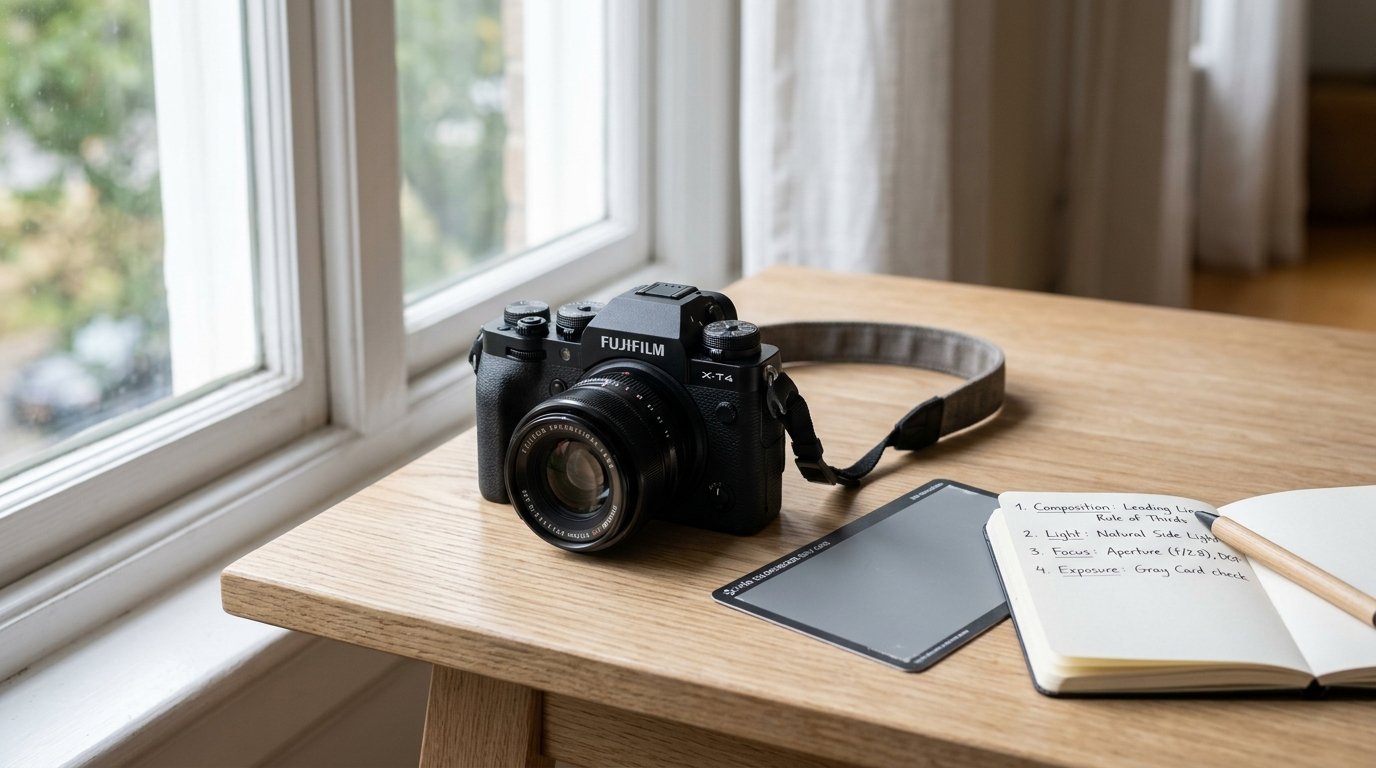
Most good photos come down to light, exposure, focus, and composition. If one falls apart, the image suffers even if the others are solid.
Light shapes mood, color, and texture. Exposure controls brightness. Focus tells the viewer what matters. Composition organizes the frame so the eye lands where you want it.
This gives you a practical troubleshooting system. If a shot fails, ask: was the light poor, the exposure off, the focus wrong, or the frame cluttered? That question is more helpful than chasing random tips.
These four factors do not matter equally in every scene. In portraits, light and focus often lead. In action, shutter speed and focus become critical. In landscapes, light and composition usually matter most. The skill is learning what deserves priority for that subject, not using the same approach for everything.
Start with Light, Because Light Makes or Breaks the Shot
Beginners often start with settings. Pros usually start by looking at the light. Before changing anything on the camera, ask where the light is coming from, whether it is hard or soft, and whether it flatters the subject.
Soft light is easier to use. Think window light, open shade, or the hour after sunrise and before sunset. It gives smoother skin, gentler contrast, and better detail in bright and dark areas. Harsh midday sun can create squinting faces, blown highlights, and dark shadows.
A pro habit is to move the subject before touching a dial. Step into shade. Turn someone toward a window. Put the sun behind them for a backlit look. Often that one change improves the photo more than any setting adjustment.
Direction matters too. Front light is simple and even. Side light adds depth and texture. Backlight can look beautiful if you expose carefully. Learning to spot good light means you solve more problems with your eyes and feet than with your camera menu.
Get Exposure Under Control Without Using Full Manual All the Time
You do not need to live in Manual mode to shoot well. For most beginners, Aperture Priority and Shutter Priority are more useful because they let you control the key variable while the camera handles the rest.
Use Aperture Priority when depth of field matters. A wide aperture like f/1.8 or f/2.8 can blur the background in portraits. A narrower aperture like f/8 or f/11 can keep more of a landscape sharp. Use Shutter Priority when motion matters. Fast speeds freeze kids, pets, or sports. Slower speeds can show movement on purpose.
The most overlooked control is exposure compensation. If the camera makes snow too gray or a dark scene too bright, use compensation to nudge the result lighter or darker. It is one of the fastest ways to improve exposure without going fully manual.
Be practical with ISO. Raise it when you need a faster shutter speed or more depth of field. A slightly noisy sharp image is better than a clean blurry one. After important shots, check playback or the histogram and make small corrections early.
Use Focus Settings That Match the Subject
Many soft photos are not caused by bad lenses. They come from using the wrong autofocus mode.
For still subjects, use single autofocus. Place focus on the eye in a portrait or on the main detail in a close-up. For moving subjects, use continuous autofocus so the camera keeps adjusting as distance changes. That is the better choice for children, pets, sports, and street scenes.
Your focus area matters too. A single focus point is often more reliable than letting the camera choose across the whole frame, especially when the background is busy. If you give the camera too much freedom, it may lock onto the nearest object instead of the subject.
Also remember that focus and shutter speed work together. Perfect focus can still look soft if the shutter is too slow for your hands or your subject’s movement.
Improve Composition by Removing Distractions, Not Adding Complexity
Composition is often taught as a long list of rules. In practice, it is usually about subtracting distractions until the subject becomes clear.
Before you shoot, check the edges of the frame. Look for poles behind heads, bright objects pulling attention, messy backgrounds, or awkward cutoffs. Then move: step left, crouch lower, zoom in, or wait a moment. Small changes can clean up a photo quickly.
That is why pros move so much. They are not only searching for a dramatic angle. They are editing the background and arranging the frame.
Classic ideas like the rule of thirds, symmetry, and leading lines are useful, but they are tools, not laws. If centering works, center. If negative space strengthens the mood, use it. The real question is whether the frame supports the subject.
A good test is to squint at the image. If you cannot quickly tell what matters, the composition probably needs simplification.
Camera Habits Pros Use to Get More Keepers
Pros get more keepers because they rely on repeatable habits, not luck.
Check your settings before the moment happens. Missed shots often come from the wrong ISO, autofocus mode, or shutter speed left over from the last scene. When timing matters, shoot short bursts instead of holding the button down nonstop. That improves your odds without creating hundreds of duplicates.
Hold the camera steadily. Tuck in your elbows, press the shutter smoothly, and avoid jabbing at the camera. Review intelligently too: not after every frame, but after the light changes or the subject moves.
One more habit matters a lot: after getting the safe shot, make a second version. Change distance, orientation, or angle. Many of the best images happen one small adjustment after the obvious frame.
Common Beginner Mistakes a Pro Notices Right Away
A few mistakes show up again and again. The first is trusting full Auto to make every decision. Auto is convenient, but it often chooses safe settings instead of the best creative ones.
The second is ignoring light. Beginners will stand in bad light when better light is just a few steps away. Another common issue is missed focus from using the wrong AF mode or recomposing too aggressively at very wide apertures.
Clutter is also a giveaway: busy backgrounds, crooked horizons, and bright distractions near the edges make images look less polished fast. Finally, many beginners take one frame and move on, while pros usually make several small variations before leaving the scene.
A Simple Practice Routine to Improve Faster
Choose one subject for a week: portraits, food, pets, flowers, or street details. Then practice one skill at a time instead of everything at once.
Spend one day shooting the same subject in different light. Another day, practice exposure compensation. On another, test autofocus modes with still and moving subjects. Then spend a session simplifying backgrounds and framing.
At the end of the week, review your photos. Pick three that worked and three that did not. For each one, identify whether the issue was light, exposure, focus, or composition. That review process builds the pro mental model into a habit.
FAQ
What Is the Best Camera Mode for Beginners in Digital Photography?
Aperture Priority is usually the best starting point because it gives you creative control over depth of field while the camera handles most exposure decisions. Shutter Priority is best when motion matters.
How Do Pro Photographers Get Sharp Photos Consistently?
They use the right autofocus mode for the subject, choose fast enough shutter speeds, hold the camera steadily, and place focus on the most important detail. They also check results during the shoot.
Should Beginners Shoot Raw or Jpeg?
RAW gives you more editing flexibility and better recovery of highlights and shadows. JPEG is simpler and smaller. If you are unsure, RAW+JPEG is a practical starting point.
What Is the Fastest Way to Make Photos Look More Professional?
Improve your light and clean up your backgrounds. Those two changes usually make a bigger difference than advanced editing or expensive gear.
Do I Need an Expensive Camera to Take Better Digital Photos?
No. Most beginners improve faster by learning light, exposure, focus, and composition than by upgrading gear. Good technique with a basic camera beats poor technique with an expensive one.