
Quick Answer
Yes, you can use a white T-shirt as a DIY reflector for photography. The main idea is simple: place the white fabric where it can catch light from the sun, a window, or a lamp, then bounce that light back onto your subject’s shadow side.
This works best for portraits, product photos, food photos, and phone photography when the light is already fairly strong. A white T-shirt will not create light by itself. It only redirects existing light, so it needs to face both the light source and the subject.
You can use it in two easy ways: wear the white T-shirt yourself and stand near the subject, or stretch the shirt over a chair, cardboard, foam board, or hanger to make a flat reflector panel. The result is usually softer shadows, brighter eyes, and more detail in darker areas.
A white T-shirt is not as efficient as a real reflector, but it is free, portable, and beginner-friendly.
How to Think About This Topic

A reflector is not a light. It is a light redirector. That is the most useful mental model when using a white T-shirt as a DIY reflector.
Imagine sunlight coming through a window and hitting one side of someone’s face. The bright side looks good, but the other side may look too dark. If you place a white T-shirt on the shadow side, angled toward the window and the person, some of that window light bounces off the shirt and fills in the shadows.
White fabric works because it reflects light in a soft, neutral way. Unlike a mirror, it does not create a sharp beam. It scatters light, which makes the fill look gentle and natural. This is why a plain white T-shirt can be useful for beginner photography lighting.
The key is angle. If the T-shirt is facing away from the light, it will not bounce much. If it is too far from the subject, the reflected light becomes weak. If it is too wrinkled, dark, or covered in graphics, it may reflect unevenly or add unwanted color.
Think of the setup as a triangle:
- One point is the light source, such as the sun, window, or lamp.
- One point is your subject.
- One point is the white T-shirt reflector.
Your job is to place the T-shirt where it can “see” the light and “see” the subject. If both are true, it can bounce light usefully.
This technique is especially helpful when you want a low-cost solution right now. You may not have a 5-in-1 reflector, foam board, or studio light nearby, but you might have a clean white shirt. For casual portraits, travel photos, small products, and social media content, that can be enough to improve the image noticeably.
Practical Guidance
Start with a clean, plain white T-shirt. Avoid off-white, cream, neon, striped, or heavily printed shirts if possible. A bright white cotton shirt is usually best because it reflects light softly without adding a strong color cast.
There are two practical ways to use it.
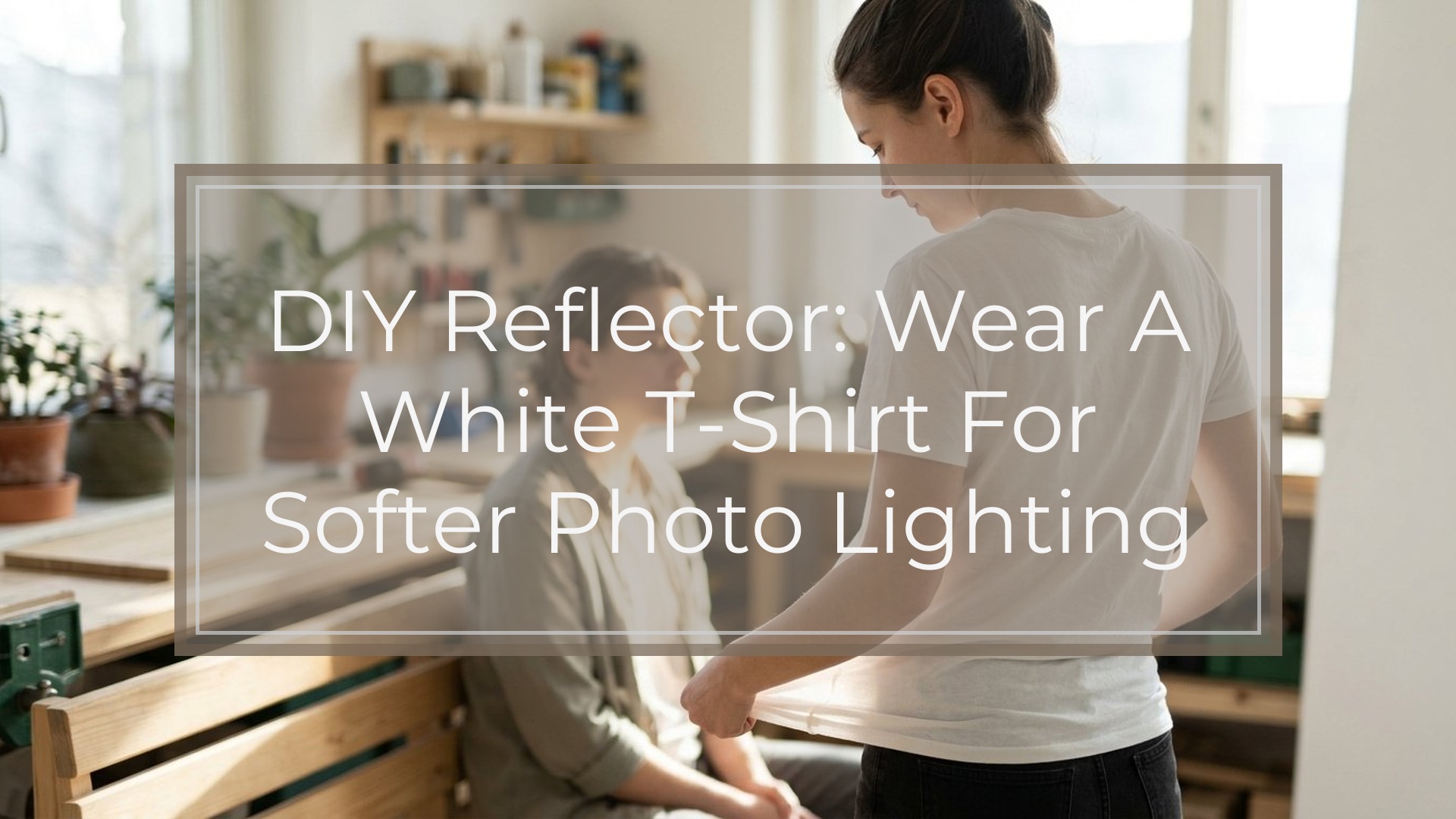
First, you can wear the white T-shirt. This is the easiest method for quick portraits. Stand close to the person being photographed, on the shadow side, and let the shirt face the light. For example, if window light is coming from the left, stand slightly to the right of the subject so your shirt bounces light into the darker side of their face. This is subtle, but it can lift shadows in close portraits.
Second, make a simple reflector panel. Stretch the T-shirt over cardboard, a large book, foam board, a chair back, or a hanger. A flatter surface gives you more predictable reflection than loose fabric. Place it just outside the camera frame, angled toward the subject.
Use this quick guide:
| Situation | Where to place the T-shirt | Expected result | Limitation |
|---|---|---|---|
| Window portrait | Opposite the window, near the face | Softer facial shadows | Needs strong window light |
| Outdoor shade | Facing open sky or sunlit ground | Gentle fill light | Weaker than a real reflector |
| Product photo | Beside the object, near shadow side | More detail and less contrast | Small objects work best |
| Harsh sun portrait | Below or beside the face | Slight shadow lift | May be hard to aim alone |
Distance matters. For portraits, start with the shirt about 1 to 3 feet from the subject. For small products, try 6 to 18 inches. Move it closer if the effect is too weak. Move it farther away if the shadows become too flat.
Watch the subject while moving the shirt. You should see the shadow side brighten slightly. For portraits, look at the eyes. A good reflector position often adds a small catchlight, making the eyes look more alive.
For camera settings, you usually do not need anything special. Use your normal exposure, then adjust if the image becomes brighter. On a phone, tap the subject’s face or product to set focus and exposure. If the scene still looks too contrasty, move the T-shirt closer instead of over-editing later.
Avoid common mistakes. Do not use a colored shirt unless you want that color reflected onto the subject. Do not place the shirt behind the subject unless you want background bounce. Do not expect it to work well in a dark room with no strong light source. And do not hold it so close that it appears in the frame unless that is intentional.
Upgrade to a real reflector when you want more control, a larger surface, silver or gold reflection, or easier handling outdoors. Until then, a white T-shirt is a surprisingly useful beginner lighting tool.
FAQ
Can Any White T-shirt Work as a Photography Reflector?
Most plain white T-shirts can work, but cleaner and brighter is better. A dull, stained, cream-colored, or heavily printed shirt will reflect less light or may add unwanted color. For the best result, use a plain bright white shirt with minimal graphics.
Is a White T-shirt Better Than a Real Reflector?
No, a real reflector is usually brighter, larger, easier to aim, and more consistent. However, a white T-shirt is free, portable, and good enough for many casual photos. It is best as a quick DIY solution, not a full replacement for proper lighting gear.
How Close Should the T-shirt Be to the Subject?
Start close. For portraits, place it about 1 to 3 feet from the subject. For small products, try 6 to 18 inches. If you cannot see the shadows getting lighter, move the T-shirt closer or angle it more directly toward the light source.
Will a White T-shirt Change the Color of My Photo?
A true white T-shirt should keep the reflected light fairly neutral. However, off-white fabric, detergent stains, colored graphics, or nearby colored walls can affect the color slightly. If skin tones look odd, use a cleaner white shirt or adjust white balance in camera or editing.
Can I Use a White T-shirt Reflector for Phone Photography?
Yes. This works very well for phone photography because phones often struggle with harsh contrast. Place the T-shirt near the shadow side of a face, product, or food shot, then tap the subject on your screen to set focus and exposure.