
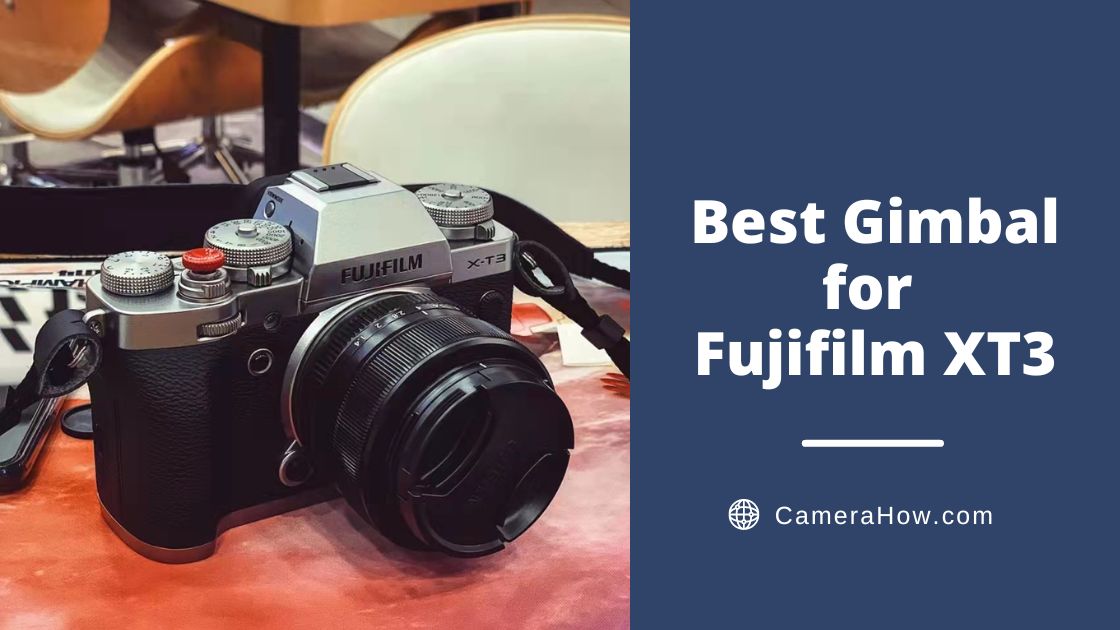
The Fujifilm X-T3 is an excellent mirrorless camera. It has 26.1 megapixels, and with its autofocus, you can quickly get great images. For Fuji fans, one of the reasons to choose Fuji is the high quality of color which has been present in successive generations. And so it is with the X-T3, which captures images in attractive colors. Moreover, the various built-in filters are a boon to lazy people and very nice to use. You don’t have to waste too much time on post-color modification.
The Fujifilm X-T3 is still suitable for use today. It can shoot 4K DCI 60p, ALL-Intra 24p 400Mbps, 10bit 4:2:0 internally.
However, X-T3 doesn’t have IBIS. So in this article, I will filter and share some gimbals for XT3. I hope it will be helpful for you.
Quick Summary
All things considered, I would recommend the Zhiyun Weebill-S as the best overall gimbal for the XT3. I don’t think it is the best gimbal on the market today, but it is the best value for quality. This gimbal is perfectly compatible with the XT3, and you can control the camera through the gimbal. Also, it can provide many shooting effects paired with the camera’s film filters. You can use it to create many excellent videos.
Best Gimbal for Fujifilm X-T3


If you ask me what is the most popular thing at the moment, my answer would definitely be video creation. There are short videos that can be shared casually and long videos that contain great camera language. While the brilliance of the video depends on your creativity, a suitable device helps you even more. And this Zhiyun Weebill-S is a perfect device.
Of course, as I mentioned, this gimbal is not the top of the line. However, it is just suitable for Fujifilm XT3 shooting needs. I’ve tried linking the XT3 with the Zhiyun Crane M-series gimbals, but they’re not very compatible. If you’re looking for an exclusive gimbal for the XT3, the Zhiyun Weebill-S is an excellent choice.
Weight&Load
The Zhiyun Weebill-S is a very lightweight gimbal. It weighs 0.92kg but has a 2kg load capacity, and the XT3 camera itself weighs around 550g. That means you can change many strong lenses for it and shoot different effects. And the Weebill-S can fully withstand its total weight.
Multifunctional Tripod
A tripod is included in the standard version of the Zhiyun Weebill-S by default. This portable tripod has a lot to offer. In addition to unfolding as a tripod, it can also be used as an extension handle and underslung grip. Together with the Weebill-S light enough body, you can hold it for a long time and not feel tired. Of course, it is very well made as the most frequently used accessory. The tripod is made of metal and leather design, which is very comfortable and soft to the touch.
Double Quick-Release Plate
The extended pad and quick-release plate are definitely the finishing touches to achieve portability. In my opinion, a significant obstacle to the popularity of gimbals is the complexity of leveling. Using the quick-release plate can significantly simplify this operation so that users can quickly master a short time. After becoming familiar with the installation, the entire camera installation and leveling process takes about 3 minutes. First-time users can complete the installation in about 10 minutes.
Three-Axis Locking
Zhiyun designed three locking switches in the Weebill S’s three axes. The role of these three clips is not actually to assist in the shooting but to facilitate the carrying and storage. After locking, whether it is put in the bag or held in hand, the axis will stay stable. The locking design can ensure the solidity of the underslung mode to protect the camera from accidental falling. Of course, another benefit of the lock is that it helps to balance the camera quickly. It can effectively prevent the camera from shaking irregularly during leveling.
8th Stabilization Algorithm
Zhiyun Weebill-S uses the 8th honeycomb stabilization algorithm. It can bring highly high stability to the picture. When walking normally, the gimbal absorbs most of the shake. The anti-shake performance in trot mode is excellent, and the image is entirely usable. It is beneficial when shooting motion-following scenes.
Creative Shooting Effects
In addition to providing pitch axis lock and POV mode, Weebill-S also provides a lot of creative shooting play. Mad Dog Mode and Dream Space are both special effects shooting techniques that can enhance the quality of the image and creativity. After mastering them, you can create professional-grade special effects videos.
Runtime
Zhiyun Weebill-S uses 18650 batteries. Two 18650 batteries can support WEEBILL-S for 14 hours. That’s basically a full day of shooting. If you have extra batteries, you can always replace them and extend the runtime even further.
Pros
- Small and light (0.92 kg/ 2.05 lbs)
- 8th instune algorithm
- High compatibility
- Dual handle design for labor-saving
- Double-quick release plate
- Carry pot mode
- Quick reference adjustment
- Six creative shooting modes
- Long-lasting battery life (14 hours)
Cons
- Poor display screen
- UI design doesn’t make sense and can be mistouch


DJI RSC is a professional gimbal designed for mirrorless cameras. It is very light in hand but powerful in performance. The overall structure of this gimbal is compact, and the controls are very responsive. It can be used for many shooting scenarios. So to speak, this gimbal allows you to complete professional photography by yourself.
Weight&Load
DJI RSC’s structure is mainly made of aluminum alloy and weighs only 1.1kg. The unique design makes it very comfortable to handle. This gimbal has a 2kg load capacity, which is no problem with XT3 and some long lenses.
APP Function
With the Ronin APP, DJI RSC can still achieve some additional functions. It can provide time-lapse, motion-lapse, motion-control, and other shooting techniques.
Titan Stabilization Algorithm
Although the market time of DJI RSC is very early, it can still provide good stability. DJI continues to optimize the gimbal stabilization algorithm so that it can deal with various complex environments. In motion mode, the gimbal will detect changes in user movement in real-time. By dynamically adjusting the following speed of each axis, it can follow swiftly and easily shoot various fast-movement shots.
Three-Axis Lock
DJI RSC also designed independent locks for each axis. Their function is the same as that of the Weebill-S. It is convenient for leveling and, at the same time, more suitable for storage. After the first leveling is completed, you can use the memory slider to fix the camera leveling position. The same set can be quickly put to work without having to level it again.
Brand Guarantee
I actually agree with a friend of mine: if you choose DJI, you choose quality and professionalism. Moreover, the price of this gimbal is amicable. Whether it’s for a newbie just planning to start photography or a photographer temporarily in a tight situation, this gimbal is a good transition.
Pros
- Easy to balance
- Compatible with most cameras
- Powerful ronin application
- Stable and solid construction
- Price friendly
- Smart follow
- Remote control
Cons
- No screen. You need to determine the mode by yourself
- Extra grip is required for pot lifting mode


I’ve always been a fan of both Zhiyun and DJI because I think they’ve always led the field in gimbals. But sometimes you just want a gimbal that can carry a camera to capture some funny things in life. Or to record the beauty when you are traveling.
So, in some cases, you might think more about weight and cost instead of functionality and extreme stability. Especially when considering the positioning and price point of the camera, you may need to redefine your goals and needs.
So, here’s a gimbal that fits the bill: the Feiyu G6 Max, a compact gimbal that’s certainly not a high-end product. And when you find out its price point, you’ll be surprised.
Weight&Load
The Feiyu G6 Max itself weighs less than 0.7kg but has a load capacity of 1.2kg. The XT3 camera weighs in at around 550g. That means you have some extra weight to allocate to the lens. It can easily carry micro-single, cell phones, sports cameras, and card cameras. One gimbal can meet your multiple shooting needs.
Three-Axis Lock
It has the same function as the Zhiyun Weebill-S. The lock can fix the three axes when leveling and storing to prevent shaking.
Special Effects
The G6 Max is equipped with nine special effects shooting modes to meet the needs of professional and daily recording, such as POV, vertical shooting, 360° rotation, etc. The special effects are beneficial. This gimbal can make every shot at movie level, and there is no need to use APP. You can also operate it with one hand.
Waterproof and Dust-Resistant Design
Feiyu G6 Max features splash-proof technology for splash-proof and dust-proof performance. It can follow the shooter into various complex shooting environments and truly work side-by-side.
Runtime
The G6 Max can run for 9 hours on a full charge. It can charge the camera at the same time, which consumes extra power.
Lack of Compatibility With X-T3
Of course, I must emphasize that the G6 Max is very incompatible with Fujifilm. It is unlike DJI or Zhiyun, where you can adjust the camera with the gimbal. It only supports start shooting and close shooting, as well as manual focus. But for some photographers who do not require compatibility, it is an excellent choice for XT3.
Pros
- Small, lightweight (660g/1.47lbs)
- Price friendly
- Three-axis lock
- Quick release version
- Multiple shooting effects
- Can carry cell phones, sports cameras
- OLED screen
- Long battery life (9 hours)
Cons
- Limited load capacity (1.2kg/2.64lbs)
- Not very compatible with XT3
- Extra handle required for underslung mode


DJI RSC 2 is a gimbal dedicated to DSLR and mirrorless cameras. It is an excellent alternative to the Fujifilm XT3 and is compatible with the XT3 very well. You can adjust various settings of the camera via the camera control cord. And the high-end price point often brings higher-end features and stability. Let’s take a closer look at this gimbal.
Weight&Load
There is no doubt that the DJI RSC 2 has a powerful load capacity. Its own weight is 1.3kg, but it has a 3kg load capacity. It gives you more options when it comes to lenses for the XT3. With the high color retention of the Fuji camera itself, you can create some beautiful shots without stress.
Titan Stabilization Algorithm
The Titan stabilization algorithm makes the RSC 2 even more powerful! It’s no exaggeration to say that it can deliver even more stable and smooth images than the RSC, and the DJI RSC 2 has a Super Stabilization mode to harness the algorithm’s power further. When Super Stabilization is turned on, the footage of many moving scenes can also be kept stable.
Foldable Structure
The most striking feature of DJI RSC 2 is its foldable design. As a result, the RSC 2 has as many as six ways of transformation. It can be freely switched to handheld, vertical shooting, underslung, and other structures. That can meet the needs of different shooting places. But some forms have unreasonable shapes, which may be a bit laborious.
Front Fine-Tuning Wheel
RSC 2 adds a front dial to adjust the focus and direction. Just turn it with one hand, and you can control the focus and direction of the camera. This design is very convenient.
Creative Shooting Effects
This function is the same as DJI RSC, including POV and 360° selective shooting. DJI RSC 2 has added a new function for panorama shooting. It can take multiple photos by turning the camera and combining them into one giant picture.
One-Touch Vertical Shooting
DJI RSC 2 can switch to vertical shooting mode with one click. It helps you make more professional vertical videos. Present higher-quality content on social media platforms. You don’t need an extra grip either because it can be transformed into a vertical structure.
Runtime
DJI RSC 2 uses advanced battery technology to charge up to 70% in 1 hour with fast charging. And its maximum battery life is further increased to 14 hours.
All things considered, the DJI RSC 2 is excellent. It is also currently very compatible with the XT3. That is a suitable gimbal if you want to shoot a video with color and stability.
Pros
- High load capacity (3 kg/ 6.6 lbs)
- Double-quick release plate
- Foldable design
- Quick Switch to Vertical Shooting
- Eagle eye image transmitter
- 14 hours battery runtime
- Remote Control
Cons
- Some functions need to be used with APP
- Small black and white screen (1 inch)
- Partially deformed structure strains


If you ask me what is the best gimbal on the market today, then the DJI RS 3 definitely ranks up there. This gimbal is geared towards professional photographers and teams and offers ultimate service. It includes the features of the DJI RSC 2 and returns to the traditional detachable battery structure. DJI has designed it with more professional and convenient features to make it stand out.
Weight&Load
The RS 3 weighs 1.3kg and also has a 3kg load capacity. It is made of aluminum construction, which makes it solid and reliable. This gimbal is also highly compatible with the XT3. It supports adjusting the camera settings using the camera control cable.
3rd Titan Stabilization Algorithm
DJI RS 3 can bring more stable images. After testing, the performance of RS 3 is 20% higher than RSC 2. It also has a super stabilization mode to improve image stability further.
Instant mode switching
In addition to continuing the front dial design of the RSC 2, the RS 3 also adds Instant mode switching, which allows you to adjust between PF/FPV/PTF with a slider. This feature allows you to quickly switch between shooting modes without having to open a menu to select.
Autonomous Axis Locks
Autonomous axis locks are a new feature. Press the power button in the off state. The RS3 can expand the three axes and enter the working condition within 2 seconds. And if you press the power button again, the three axes will return and lock, easy to carry. It can effectively shorten the preparation time for shooting.
Bluetooth Shutter Control
DJI RS 3 can control the shutter via Bluetooth. If you accidentally forget your camera control cord, you can use this function instead of wasting time returning to get it. Also, the RS 3’s Bluetooth has a memory function, so you don’t have to balance the same camera repeatedly.
Removable Battery Structure
Unlike the RSC2, the RS3 has switched back to the removable battery structure of the RS2. Not only is it easy to store, but it is also smaller in size. When fully charged, the DJI RS3 will run for 14 hours. And, if you carry an extra battery, the range will be further extended.
Pros
- High weight capacity (3 kg / 6.6 lbs)
- Instant mode switching
- Double-quick release plate
- Fine-tuning knob
- Autonomous axis locks
- Full-color touch screen
- Wireless image transmitter
- Removable battery handle
- Remote control
Cons
- Some functions need to be used with APP
- An extra grip is required for underslung mode
- Want time to learn
What Is a Gimbal?
The main purpose of a gimbal is to keep the camera steady to produce smooth and fluid images.
If you just hold the camera and shoot a video, you will find the resulting video shaky. Especially at the edges of the picture, there will be jam-like shaking. These shakes will be produced even if you use very smooth footwork. So, a gimbal is necessary to make a video.
What Do You Need to Consider When Choosing a Gimbal?
Stability
Stability is the most important feature of a gimbal. A great gimbal can provide excellent stability in different shooting environments.
Compatibility
You should ensure that the gimbal is compatible with your camera and lenses. Of course, this depends on how much you care about the compatibility of the gimbal. Some gimbals are so compatible that you can control your camera’s functions with the gimbal’s buttons. Some gimbals are incompatible and can only trigger the shutter and manual focus.
DJI and Zhiyun have high compatibility with Fuji cameras. Other brands, such as Feiyu, Moza, etc., are not compatible enough.
Load Capacity
Load capacity is the maximum weight that a gimbal can carry. That should include your camera and the giant lens you are likely to use. Make sure you choose a gimbal that can handle them.
Self Weight
It’s worth noting that many of the best gimbals available today weigh around 1kg. Although lightweight gimbals are better for the job, sometimes a heavier gimbal is not a bad idea to get more stability and assistance.
Runtime
Runtime is essential when you’re shooting outdoors for long periods. Of course, many gimbals now offer a solution. Many gimbals are equipped with fast charging capabilities, you only need to charge for 2 hours, and you can basically meet the workload of the whole day.
Cost
It doesn’t mean that the most expensive gimbal is the best. When a gimbal can meet both your budget and needs at the moment, it is the best for you. Photography is a long-time activity, and there will be better and more economical gimbals in the future.
Easy to Use
A user-friendly gimbal can save us a lot of preparation time. You don’t want to spend 5 minutes balancing your camera every time you shoot.
Additional Features
Select the features that interest you. Make sure these are features you might use rather than being bewildered by the fuss.
How to Balance a Gimbal?
Some friends often ask me the same question. How to balance a DJI, how to balance a Zhiyun, and so on.
In fact, the way to balance a camera and a gimbal is, to a large extent, the same. No matter which gimbal you use, these methods are, to some time, common.
Here is how to level a gimbal. Of course, it takes time to master.
- Install the quick-release plate for your camera. Usually, you need to use screws and quick-release plates to hold the camera in place and determine its position.
- Next, lock the gimbal in a balanced state with the gimbal turned off. You can use the axis lock to fix the three axes.
- Unlock the pitch axis. Adjust the position of the quick-release plate and the axis until the camera can be stationary anywhere in this direction.
- Unlock the roll axis. Adjust the left and right positions of the quick-release plate until the camera can be stationary anywhere in this direction.
- Unlock the yaw axis. Adjust the distance between the front and back of the axis. You can tilt the gimbal to place until the camera can be stationary in any position.
- At this point, the gimbal leveling work is completed.
Conclusion
After the ver 3.1 patch, many gimbals can already support XT3. However, when you plan to pick a suitable gimbal for XT3, you still need to think more about it first.
Of course, choosing a gimbal is not a difficult task. As long as you keep your budget and needs in mind and follow this principle, it’s only a matter of time before you find the suitable gimbal.