
If you’ve never used a gimbal before, you’re seriously missing out. They’re game-changing tools that can help you get the best shots by steadying your camera. It allows you to automate your rotation and angles just with a touch of a button.
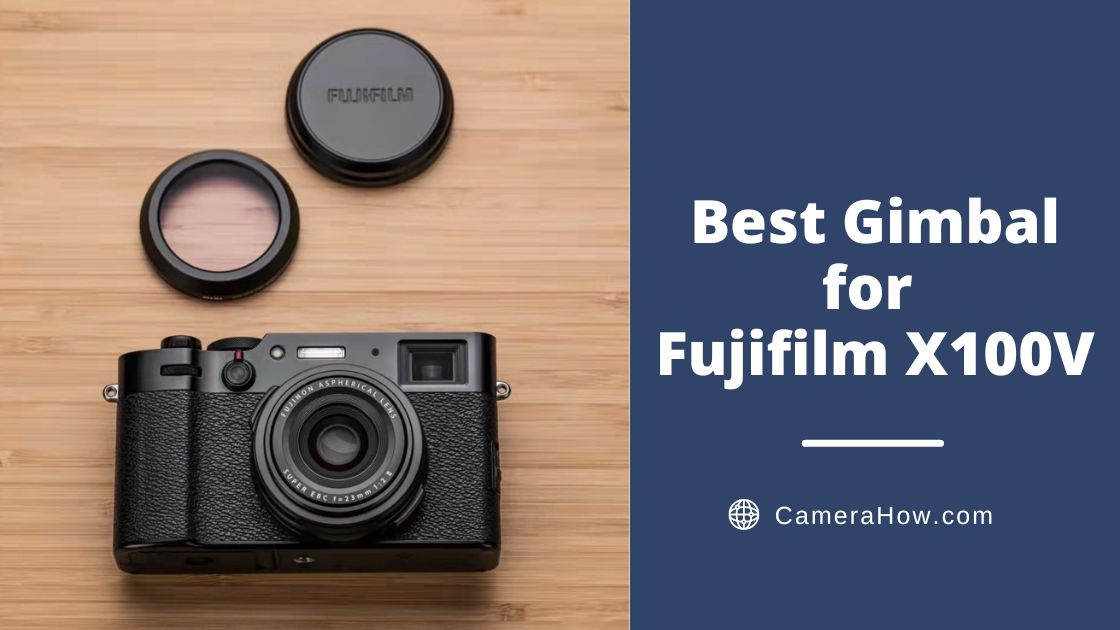
My favorite gimbal for Fujifilm X100V is the Zhiyun Crane M3, which stands out with its rare combination of features. However, several other great options are worth looking into as well. Below, I’ll show you some of the best gimbals for Fujifilm X100V. Are you ready to take your photography game to the next level?
Best Gimbal for Fujifilm X100V


This gimbal is one of the most lightweight gimbals on the market. It’s also as small as a water bottle.
Despite this, it still packs an impressive punch with its features and has a user-friendly yet sleek design. It has a 1.22″ OLED touch screen that displays stats related to the camera and gimbal, such as battery level. It allows the user to adjust settings and shot parameters, as well as view camera footage. Its joystick buttons are larger than many other gimbals, and it sports an ergonomic handle that isn’t too large or too small.
It’s worth noting that many large gimbals that are more expensive and have more advanced features don’t have a well-sized OLED touch screen, let alone other small gimbals on the market.
Pros
- Low weight and compact design
- OLED touch screen
- Bluetooth camera control
- Improved brushless motors and intuitive design
Cons
- Short battery life
- Additional purchase for accessory mout


At about 1.2 pounds, this model is only slightly heavier than the Zhiyun Crane M3, thus making it much lighter than many other gimbals.
It doesn’t have many extra features beyond those that are standard for gimbals. This may make it an ideal option for those who get overwhelmed when there are too many advanced gimbal features or who are beginners when it comes to gimbals.
Despite its weight and size, it has a solid battery life of 10 hours, which is standard. And it is longer than that of the other lightweight model reviewed in this article, the Zhiyun Crane M3.
Pros
- Affordable price
- Lightweight
- Compact design with relatively simple features
- Fast charging time
Cons
- No OLED touch screen
- Difficult to operate


The FeiyuTech SCORP-C’s unique “underslung” handle design makes this model one of the most versatile and ergonomic in the market. As the design makes it much easier to shoot from any angle and tightly control the lenses and direction of the shot.
This feature would be great for me to have during the many times that I film fast-moving wildlife or have to weasel my camera through shrubbery and woods at awkward angles to capture the perfect plant shot.
Another standout feature of the Scorp – C is that it’s both a hand-held gimbal and a tripod gimbal all-in-one. The tripod posts allow you to support the rear weight of the camera on your forearm, which can be a great aid during live-action shots.
The tripod feature, of course, also accommodates hands–free filming and photography when you place it on the ground or another place. This feature would’ve saved me aches and pains and improved the quality of my footage if I had it when I filmed long segments of wildlife activity or when I did time-lapse videography.
Pros
- High payload
- Unique underslung handle design
- Large and sturdy joystick
Cons
- Heavy


The DJI RSC has a solid payload of 4.4 pounds and a good battery life of 11 hours when fully charged.
However, the feature that stands out the most in this model is its sophisticated sport mode, which fine-tunes each axis on the gimbal to adjust for sudden changes in movement and direction. This feature makes this model ideal for following fast-moving subjects without missing a beat.
The sport mode would help me improve the quality of my footage when I suddenly adjust my camera’s direction when following fast–moving wildlife and objects, especially when they’re far away.
Pros
- Suitable for long time use
- Easy to switch battery
- Relatively affordable price
Cons
- Challenging to balance
- Thick handle unfriendly for small hands


I think the DJI RS 3 is ideal for those who want an advanced, robust gimbal and who are already very familiar with gimbals.
This model has the highest payload out of all the models reviewed in this article, 6.6 pounds. Another feature that makes this model stand out is Ronin SC’s 3rd generation algorithm, which improves the level of stabilization this model provides so much so that it can give seamless shots from moving vehicles!
The DJI RS 3 supports faster assembly and disassembly than many of its competitors. With one press of the power button, the axes automatically unlock and expand when powering on the gimbal and automatically lock and close when powering the gimbal off.
This feature would be really useful for me during those many times when I’m in a hurry while wrapping up filming and shooting.
Another feature I particularly liked about this model is that it has a 1.8″ OLED touch screen, which is larger than the touch screens featured by many of its competitors. When I’m dealing with a more advanced piece of equipment like the DJI RS 3, a larger touch screen is even more important to me, so I can easily visualize and keep track of settings, stats, and camera footage.
Pros
- Automatic locks on axes
- Large OLED touch screen
- Advanced stabilization algorithm
- High payload of 6.6 pounds
- Long battery life
Cons
- Comparatively expensive
- Heavy
Cost & Advantages of a Gimbal
Gimbals can provide the same type of memorable cinematic quality that dollies, Steadicams, and drones provide without the very high price tags associated with those devices. They’re also usually easier to use.
Lower-budget gimbals supporting compact, action, and DSLR mirrorless cameras can start at around $250. Higher-budget gimbals that support even more camera types and come with a nearly dizzying slew of features and customizations can fetch upwards of $1,100 or more.
Meanwhile, Steadicams can cost tens of thousands of dollars, and drones suitable for cinematic-quality footage can start at around $1,300.
What You Need to Assess Before Buying a Gimbal?
Type of Camera & Accessories
One of the first things you’ll want to consider when deciding what kind of gimbal to buy is the type of camera and accessories you’ll be using. Some gimbals only support smartphones or GoPros, some don’t come with built-in support for certain types of cameras, and some don’t support certain camera types even if an accessory mount is bought.
If you plan on using lots of interchangeable lenses, you’ll also want to make sure the gimbal supports that, as many of the lower-budget gimbals are limited in this regard.
You’ll also want to assess the weight of the camera(s) and accessories you plan on using, as gimbals vary widely in their payloads, i.e., the weight that the gimbal can support while still being able to do its job well.
If you get a gimbal whose payload is below the weight of your camera and accessories, the gimbal won’t be able to stabilize your shot properly. It’s usually best to go with a gimbal whose payload is a bit more than the weight of the camera and accessories you’ll be using with it.
Weight
Some gimbals are as lightweight as smartphones and can thus easily be carried around from place to place or held for long periods of time. Others are like carrying around heavy-duty equipment. This factor depends, of course, on your stature and what weight you can comfortably hold for extended periods of time.
Even if it doesn’t feel heavy at first, a heavier gimbal may start to become quite bothersome hours into using it. If you’re looking for the lightest-weight gimbals on the market, buy the Zhiyun Crane M3 or Zhiyun M2S.
Type of Shots
Some gimbals are designed for more casual filming and less intense shots that don’t require you to get in hard angles or accommodate more abnormal subjects. If this is what you’re looking for, the Zhiyun M2S would be ideal.
Conversely, other gimbals are designed to accommodate cinematic movie-making, difficult angles, and fast movements. The FeiyuTech Scorp-C and DJI RS 3 are what I would recommend for that.
Tripod vs. No Tripod
If you’re investing in a heavier gimbal or do a lot of stationary shooting and filming, it’s probably best to get a gimbal that has tripod supports. These will give your arms a break and more easily accommodate a wider variety of shots because you’ll be able to set it down practically anywhere. If this is what you’re looking for, the FeiyuTech Scorp – C is the best option.
On the other hand, if you follow fast-moving subjects a lot and move with your gimbal, it may be best to get one that can only be hand-held, as tripod supports in these cases would make it harder to move quickly with the gimbal.
OLED Screen vs. No OLED Screen
Are you a visual person like me who likes to view your gimbal action in real time and monitor your gimbal’s stats on a screen? If so, you’ll definitely want to get a model that has a nicely sized OLED screen, as this will allow you to do exactly that.
Look no further than the Zhiyun Crane M3 if you’re also looking for a lightweight, compact model. If you’re looking for a larger OLED screen and more features, get the DJI RS 3.
Battery Life
Some gimbals have a battery life of 12 – 13 hours (rarely is it longer than 13 hours), which makes them ideal for all-day continuous shooting. The gimbals with longer battery lives are usually heavier and have more features and support. If this is what you’re looking for, you’ll want to buy the FeiyuTech Scorp – C or DJI RS 3 from this list.
On the other hand, if you’re not usually doing all-day shoots, you may want to just go with a gimbal that has a standard battery life of 8 – 10 hours, like the Zhiyun Crane M3 or Zhiyun M2S.
Conclusion
The Zhiyun Crane M3 is the best gimbal for Fujifilm X100V because of its unique design. It’s one of the lightest gimbals on the market and has a compact and intuitive design, both of which make it easy to operate for both beginners and those who are familiar with gimbals.
Despite its stature, it has extra features that often don’t appear on heavier, more expensive gimbals, like the DJI RSC or Feiyutech Scorp – C, such as a nicely sized OLED touch screen and large ports that support very high-quality audio. While Zhiyun didn’t publish the exact payload of the Crane M3, it’s compatible with compact and mirrorless DSLR cameras, meaning it can support the Fujifilm X100V.
The runner-up is the FeiyuTech Scorp – C. Its underslung handle and tripod design support high-quality stabilization for any kind of shot, and its joystick is one of the easiest to use on the market. It’s also one of the most affordable advanced gimbals out there.
Now it’s time to test one of these gimbals for yourself!