
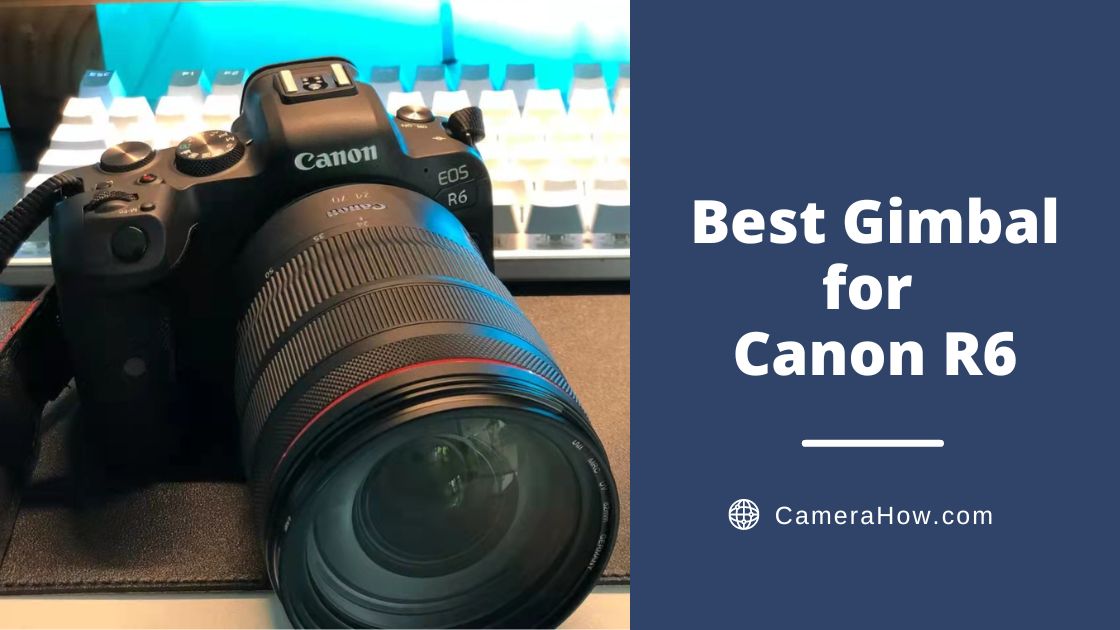
After Canon released the full-frame EOS R5 and R6 in July 2020, these two cameras have been the focus of photography enthusiasts.
Especially the Canon EOS R6. It has high picture quality, excellent user experience, and attractive pricing. That makes R6 the darling of the camera market and one of the best-selling full-frame mirrorless cameras.
However, just using a camera, you’ll be hard-pressed to shoot great movies and videos out of the box.
If you plan longer video sessions, this guide on Canon R6 overheating may also help.
That is why I am more inclined to choose a suitable gimbal.
In this article, I will filter and recommend best gimbal for Canon R6. I hope it will be helpful to you.
What Is a Gimbal?
A gimbal is a device used to keep the camera steady. It can solve the problem of shaking when shooting with a handheld camera.
Best Gimbal for Canon EOS R6
Overall, I think the most suitable gimbal for the R6 is the DJI RS 3. This new-generation gimbal created by DJI seems to be a new revolution. 3kg load capacity, but only 1.2kg weight. Equipped with the latest Taishan 3.0 stabilization algorithm, it is compatible with most lenses. Image transfer and remote control are excellent. Fine-tuning buttons and quick-release plates make balancing easier. Of course, these are just the tip of the iceberg, and it’s much more than that.
I can’t deny that the DJI RSC 2 was my right-hand man until I updated to the DJI RS3. I don’t think it has any downsides. It has the same load capacity of 3kg, sturdy and durable. Moreover, the body of the DJI RSC 2 can be folded, which adds to its charm based on rich functions.
Well, I know many people prefer to travel freely because carrying extra equipment is painful. That’s why I recommend Zhiyun Weebill 3. It has a built-in flash and microphone, which are comparable to professional equipment. This gimbal has a battery life of up to 21 hours. Let the power bank go to hell! Haha. Just kidding.
Some friends will ask if there are more economical options. Well, there are. According to my usage habits, I would recommend DJI RSC. That’s right, it’s DJI again, even if it’s the first generation of the Ronin series. This gimbal is still excellent. There aren’t many extra features, just a gimbal that does its job.
I’ve always been a fan of DJI and Zhiyun, and I think their gimbals are useful. But my friend recently shared with me a new gimbal which intrigued me. It is the FeiyuTech SCORP-C. What attracts me about this gimbal is its affordable price but dual handle structure. I know that the current video platforms (like YTB or TWTR) are keen on short videos. This gimbal is one of the newest and most affordable short video gimbals you can get.
Do you want to unleash the full power of the R6? Do you want to be a professional-level photographer? Whichever you choose, the DJI RS3 Pro has you covered. It represents the technical strength of DJI in the field of professional photography and is one of the most powerful gimbals.


The DJI RS 3 has become the new favorite of many photographers and filmmakers. This gimbal has been capturing the hearts of photographers since its launch.
The DJI RS 3 has Titan Algorithm 3.0, DJI’s latest stabilization algorithm. Based on this algorithm, the gimbal minimizes picture shake. Even when shooting in high-speed movement, the picture can maintain a smooth level.
The powerful motor can support various twists and special movements. At the same time, you can start the super smooth stabilization function when necessary. This function can further strengthen the motor to keep the picture stable.
The fine-tuning knob is located next to the axis, which allows you to fine-tune the position of the camera and lens. That helps control focus as well as prevent collisions. DJI RS 3 can get into work quickly by removing and installing the camera with a double quick-release plate.
There are two features I like better, and auto axis lock is one of them. This feature allows the motor to switch modes quickly, and the three axes will automatically shrink and fold for easy portability. When you press the power button again, it will quickly unfold and enter the working state.
Another feature I like is instant mode switching. There is a mode-switching knob near the handle, which allows me to switch modes without entering the menu. While its 1.8inch full-color touch screen is very convenient (and really excellent actually), this button gives me a better experience.
There are also some handy features. The removable battery structure prevents me from connecting the entire gimbal to a power source for charging. The wireless image transmitter can make the phone monitor the footage taken by the camera in real time. The remote control allows the camera to simulate the motion of the phone.
DJI RS 3 is a perfect gimbal. Even now, it continues to surprise me.
Pros
- High load capacity (3 kg / 6.6 lbs)
- Instant mode switching
- Quick release plate
- Fine-tuning knob
- Autonomous axis locks
- Full-color touch screen
- Wireless image transmitter
- Removable battery handle
- Remote control
Cons
- Some functions need to be used together with APP
- Underslung mode requires an additional handle


DJI RSC 2 is another great choice for the Canon EOS R6. Even now, I really like this gimbal.
The battery with PD fast charging takes only two hours to charge fully and can run up to 14 hours. When out shooting, the DJI RSC 2 performs very well.
I’ve tried connecting the R6 to the RSC 2, and it performs just as well. You can adjust the parameters of the camera via the camera control cord. Of course, the DJI RSC 2 also uses a double quick-release plate structure, so you can quickly remove and install the camera. But it is no fine-tuning knob. You need to adjust it manually.
The unique picture transfer function is very useful. You can transfer the images taken by the camera to your phone synchronously. That will facilitate you to monitor and adjust the images being taken by the camera.
When it comes to DJI RSC 2, you can’t get around its folding function. The DJI RSC 2 can be transformed into six structures. These structures are designed to meet different shooting environments. It can change to vertical shooting mode and underslung mode very quickly. You don’t need an extra handle. This gimbal has a lot of joints and is tightly bonded to each other.
You will see that I also wrote about its folding structure in the cons precisely because of its very tight joints. It will be a bit of a struggle to deform, which is a test of my strength. But maybe it’s just right for people who like fitness exercises. Ha ha.
Pros
- High load capacity (3kg/ 6.6 lbs)
- Double layer quick release plate
- Foldable design
- Vertical Shooting
- Image transmitter
Cons
- Some functions need to be used with APP
- Poor screen
- Foldable design


As the newest member of the WEEBILL series, Zhiyun provides the same exquisite design and powerful functions for WEEBILL3. Undoubtedly, it is another gimbal that is perfect for EOS R6.
The body of this gimbal is the size of an A4 sheet of paper and weighs only 1.13kg but has a 3kg load capacity. It’s easy to carry around and fit right into your backpack. Carrying a heavy gimbal around is a real pain, so I prefer lighter and smaller gimbals.
Of course, the fantastic thing for me is the battery runtime! It lasts for 20 hours on a full charge! That’s a bit crazy. What’s even better is that with the fast charging system, you can have it fully charged in just 2 hours. I asked a friend of mine who is a professional outdoor photographer, and he is a big fan of Zhiyun. He told me he carries the Zhiyun Weebill 3 when he goes out for long periods of time. Although he hasn’t had the experience of shooting continuously for up to 20 hours, he really doesn’t need to charge the gimbal very often.
On the other hand, the popular underslung design also appears on the new stabilizer this time. Based on the ergonomic design optimized structure, users do not easily feel tired while using the gimbal for a long time.
I must say that Zhiyun is working to simplify the gimbal and optimize the user experience. It is indeed taking action. What attracted me most to this gimbal is, of course, its built-in light & Mic. The fill light peaks at 1000 lux and can be adjusted for brightness by percentage. It has a color temperature range of 2600K to 5400K.
The Mic is a professional-grade noise-canceling fidelity microphone. It solves the problem of cumbersome wiring for external radios. Carry this gimbal, and You are equivalent to carrying a photo studio.
Pros
- Lightweight
- Wrist rest structure
- Built-in hi-fi microphone
- Built-in fill light
- Long runtime (21 hours)
- Quick release plate
Cons
- Poor screen
- not so good APP


DJI RSC is the first generation of the DJI Ronin C series. Of course, nowadays, it’s become a budget-friendly gimbal. If your budget is tight for the time being, this gimbal is also a good choice.
The DJI RSC uses the Titan algorithm and comes with a powerful motor. It has all the features to work with the Canon EOS R6. Of course, this gimbal itself doesn’t have many extra features.
Yes, the important feature of this gimbal is stability. It will provide outstanding stability in its class. When you balance the camera well, it rarely shakes and can easily adjust the camera.
Pros
- Easy to balance
- Compatible with most cameras
- Powerful ronin APP
- Stable and solid structure
- Price friendly
Cons
- No display screen
- No extra functions


As I said, I usually don’t recommend gimbals other than DJI and Zhiyun. However, the newly launched FeiyuTech SCORP-C still caught my attention.
In a nutshell, this gimbal is for people in a budget situation but want to make short videos and VLOGs.
The major video platforms (like YTB or TIKTOK) seem to love short videos nowadays. In fact, they will give more traffic to vertical videos. And to shoot short videos, you must have a gimbal that includes vertical shooting mode. Of course, when switching to this mode, the gimbal usually tilts the camera up 90°, so you’ll need to lift the underslung mode to reduce fatigue.
The FeiyuTech SCORP-C has a dual grip structure that makes it easy to switch between modes. All you need to do is push the gimbal forward, which will change to underslung mode and be supported by both hands, which is very convenient.
Of course, you shouldn’t expect it to be as powerful as DJI RS 3 or Zhiyun Weebill 3.
Pros
- High load capacity (2.5kg / 5.5 lbs)
- Double grip
- Quick release plate
- Vertical Shooting
- Underslung mode
- Friendly price
Cons
- Mis-touch button
- Unstable battery life
- Limited lens support
- Offset angle cannot remove


There is no doubt that a professional-grade gimbal can make full use of the camera. And DJI RS 3 Pro is powerful professional-grade equipment. Allow me to say this about it, it’s extraordinary.
In a nutshell, this gimbal is suitable for professional photographers. Also, those who aspire to be professional photographers will do. Of course, it is ideal for teams or companies to shoot commercial footage and films.
Broadly speaking, it is an advanced version of the DJI RS 3 with a higher load capacity of 4.5 kg. That allows it to support various combinations of mainstream cameras and lenses. Let you shoot out different effects with different lenses.
With the help of wireless Bluetooth direct connection technology, RS 3 Pro can control the shutter wirelessly. The gimbal body has a memory function. The same camera does not need to repeat the balance. The new LiDAR focusing function can project 43,200 distance measurement points, up to 14 meters of detection distance. It also adds a new built-in camera with a 30mm equivalent focal length. It has a wide field of view of 70°, enough to meet the focus requests of most scenarios.
The gimbal is compatible with the EOS R6 and works very well, so even if you’re thinking of changing cameras in the future, this gimbal will do the job.
Pros
- Ultra high load capacity (4.5 kg /10 lbs)
- Automated axis locks
- Extended carbon fiber axis arms
- LiDAR focusing
- Long-Range O3 pro video transmission
- 1.8 inch full-color touch screen
- Can be paired with cantilever, slide rail
- Professional grade equipment
Cons
- Expensive
- Difficult to study
Does Canon EOS R6 Need a Gimbal?
Yes, the R6 needs a stabilizer to shoot video.
What Do You Need to Consider When Choosing a Gimbal?
Stability
It is the job of the gimbal
Compatibility
Determine if the gimbal is compatible with your camera and lens
Load Capacity
The total weight of the camera and lens that the gimbal can support
Self Weight
In actual use, the lightweight gimbal will save more effort
Cost
Decide which level of gimbal to choose based on your budget and needs
Easy to Use
Although technical knowledge needs to be learned down-to-earth, an easy-to-use gimbal can save you a lot of preparation time.
Extra Features
Many gimbals now have additional functions. Choose the function you are interested in
Why Do I Need a Gimbal?
I know you are still on the fence. Because a gimbal seems like extra overhead, I understand it. One may be referencing some negative comments about the gimbal. And the other may be related to the stabilization features of the R6.
However, years of experience have taught me that I must carry a gimbal when I want to shoot good videos, even for commercial films. Even cameras like the R6 with their image stabilizer need a gimbal.
I’d say the camera comes with an image stabilizer that does its job just to reduce the jelly-like shake around the frame. But more shake is reduced by cropping the frame, and that’s pointless. A full frame helps show a better movie effect, while cropping can destroy the whole footage.
What Should You Not Do With a Gimbal?
Use a gimbal strictly according to its instructions, and you will not encounter serious problems. But you need to check the gimbal carefully for defects before using it and replace it in time if necessary.
Of course, there are some things you need to avoid.
- Do not exceed the weight-bearing capacity of the gimbal
- Do not turn the gimbal drastically
- Do not have too strenuous movement
- Do not use the gimbal which is not compatible with the lens
- Do not crash the gimbal
- Do not be an impatient
Conclusion
Canon EOS R6 is a good camera. It deserves a good gimbal.
After reading this article, I believe you already have the right choice for your canon EOS R6. In fact, picking a gimbal is not a difficult task, as long as you know your needs and budget.
In the end, I would like to share some additional experiences. That is, first of all, you can try it before you choose it. If the gimbal is good, you will know only after you try it. That will also reduce the risk of returning the product.
Another one is that you can choose the event day before selecting the gimbal, that will help you enjoy an extra discount.