
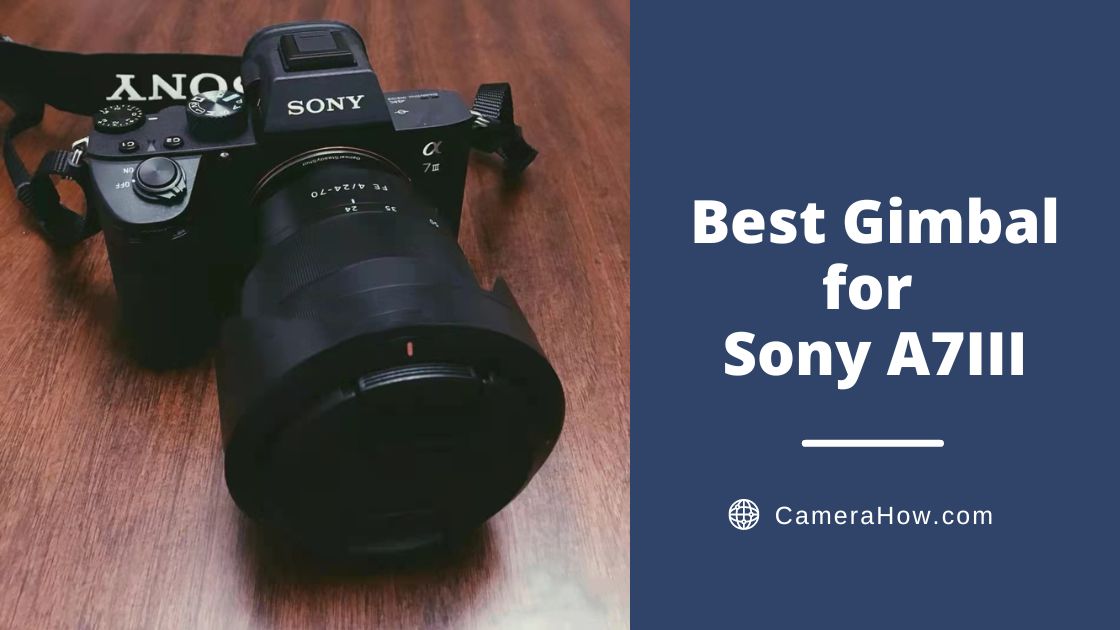
The Sony A7III is a successful camera. Sony A7M3 is an entry-level among the A7 series products! But even for such an entry-level product, its performance is still remarkable.
The A7M3 is well controlled in volume. The compact body and the weight of about 565g can make you easily carry it out.
You will find that even if a successor has appeared, the sony A7III still frequently occurs in people’s vision field.
However, such a camera, if there is no excellent gimbal, can not play all the functions.
This article will discuss and filter out the best gimbal for Sony A7III.
What Is a Gimbal?
A gimbal is a device used to stabilize the camera. It uses a series of algorithms to balance the camera shake on three axes.
A gimbal is an essential tool if you want to shoot high-quality videos.
In many cases, shooting with a handheld camera is not a good option. If you’re trying to photograph a moving object, the camera can’t handle the up-and-down movement of your run.
Best Gimbal for Sony A7III
All things considered, we think the DJI RS3 is the best gimbal for the Sony A7III. This gimbal represents a high level of DJI. DJI RS3 brings a new stability algorithm and powerful load capacity. The removable battery and one-button locking mechanism make it stand out.
In fact, just like talking about a camera and thinking of Sony or Canon, talking about a gimbal cannot be avoided without DJI. Even though it has been out for a while, the performance of the DJI RSC2 is still high. It is compatible with most cameras and lenses, and supports one-button vertical shooting. At the same time, the foldable structure makes it more convenient to carry.
If you don’t want to have many extra features, go for the DJI RSC. It has the basic performance you want at a very affordable price as a stabilizer.
If you are a traveler, then Zhiyun Crane M3 is for you. This compact gimbal is only 700g, suitable for travel. It will do the job if you like to shoot some live footage in your spare time.
It is difficult to bypass DJI and Zhiyun, but FeiyuTech Scope-C can do it. If you are working hard to shoot vlogs, please choose this gimbal. It comes with an underslung mode and vertical shooting function to help you become a Vlog master.
Now, let’s go back to square one. If you want to choose a gimbal to get started and learn how to shoot video, then select Zhiyun crane M2. It doesn’t have many extra features. It’s just for stabilizing the camera. It has a lightweight body and an affordable price. At the same time, it also allows you to learn how to use and balance the gimbal.
When it comes to the most professional performance and the largest load capacity, it’s the DJI RS2. It has the highest carrying capacity and is compatible with almost all cameras on the market. The truth is, if you’re going to get into photography, a professional gimbal is a must. As one of the most professional gimbals, DJI RS2 is very suitable.


The DJI RS 3 is a very good gimbal. It adheres to DJI’s excellent firm structure, quick installation, and quick balancing. And more than that, the DJI RS3 brings us more surprises.
The latest Tarzan Stabilization Algorithm 3.0 brings the highest quality stability. The time-lapse, motion-lapse, motion-control, and panorama functions are also present.
At the same time, it has a strong carrying capacity enough to carry most cameras and lenses. With the Sony A7III, you can use the control wires to adjust the camera’s ISO, aperture, and shutter.
The DJI RS3 did not use a folding structure, but changed it to a detachable battery structure.
Although it is necessary to remove the battery when storing it, it may be a little troublesome. However, the disassembled RS3 requires less storage space than the folded RSC2. Originally, the RSC2 was the size of an A4 sheet of paper after being folded, and the RS3 was made a little smaller than it.
After the battery support is removed, the DJI RS3 becomes a little more convenient to use. An intuitive effect is that you don’t have to connect the entire gimbal to a power source for charging. At the same time, you don’t have to hold the gimbal and power bank to shoot.
The DJI RS3 has a 1.8-inch color touchscreen. It will allow you to click on the screen to control the parameters directly. You no longer have to combine the small size screen with the control wheel.
RS3 adds a mode switch button. It can quickly switch among the three modes of FPV, PF, and PTF, reducing the trouble entering the menu settings.
Automatic locking is a genius design. DJI RS 3 can achieve two functions automatic locking and unlocking. Once locked, you can easily carry it. When unlocking, the shaft will be unlocked first, then moved to the correct position and locked again.
Pros
- High load-bearing capacity (3 kg / 6.6 lbs)
- Titan Stability Algorithm 3.0
- Double layer quick installation plate
- Simple Balance
- Automatic locking and unlocking
- Full-color touch screen (1.8 inches)
- Unique Ronin image transmission
- The battery is removable
- Fast switching mode (PTF/PF/FPV)
- Quick Switch to Vertical Shooting
Cons
- Need to use the APP
- A bit heavy


The DJI Ronin SC 2 is also a high-quality gimbal. It follows DJI’s Taishan algorithm, which can make the picture very stable.
The DJI Ronin SC 2 body uses a foldable design for convenient storage. The folded gimbal is smaller than a sheet of A4 paper and can fit in a backpack.
The DJI RSC 2 can be folded into other modes. Both vertical mode and pot lift mode are great features.
This gimbal is equipped with a unique eagle-eye image transmission function. It will synchronously transmit the pictures taken by the camera to the mobile phone for easy inspection.
You can also use DJI RSC 2 to adjust some parameters of the camera, but you need to use a cable to connect the camera and gimbal. The DJI RSC 2 does not have Bluetooth capability.
Although this gimbal also has a display, it is only black and white and cannot be touched. It is sufficient for displaying information, but not as intuitive and convenient as the DJI RS 3.
Pros
- Ultra-high load capacity (3kg/ 6.6 lbs)
- Quick mounting plate
- Powerful ronin app
- Long battery life (14 hours)
- Foldable
- Quickly mount and release the camera
- Quick Switch to Vertical Shooting
- Unique eagle-eye image transfer function
Cons
- RONIN app required
- Non-touchable display (1 inch)


It can be said that even today, the DJI Ronin-SC is still widely loved. It can be adapted to Sony A7III, and the price is very affordable. This gimbal doesn’t have many extra features. It’s just for stability.
Of course, the quality of DJI RSC itself is exceptionally high. The unique stabilization algorithm can be perfectly compatible with the camera and shoot smooth video. It also has time-lapse, motion-lapse, motion-control, and panorama functions.
DJI Ronin-SC is perfectly integrated with the Ronin app. It allows you to make a bit of camera motion to really add depth to your videos.
The powerful ActiveTrack 3.0 can simulate the movement of the mobile phone and synchronize the feedback to the camera.
The DJI Ronin-SC doesn’t come with an OLED display, so you may need to determine the mode yourself when you turn it on.
Pros
- Easy to balance
- Compatible with most cameras
- Powerful ronin app
- The structure is stable and firm
- Price friendly
Cons
- There is no screen, you need to determine the mode yourself
- Pitch range 280°, slightly lower than other gimbals
- Baby of the ancient times


If I had to choose a gimbal that is most suitable for life vlogs or travel photography, I would choose Zhiyun Crane M3.
Yes, I’m not kidding. If you are keen to record scenes in life or travel shots, then choose this gimbal.
Among the lightweight gimbals, Zhiyun Crane M3 is undoubtedly the best. Its own weight is only 0.7kg, and the volume is also tiny. You can easily stow it in your bag along with the camera.
Zhiyun Crane M3 supports many mainstream shooting modes, bringing a smooth shooting experience. The 1.22-inch color touch screen can help you monitor the parameters of the camera and gimbal and is very helpful for leveling and switching modes.
To improve the disassembly efficiency and portability of the device, Yunhe M3 adopts a quick-release design. It comes with different quick-release plates and can carry cameras of various sizes. On the one hand, the quick-release plate can improve the efficiency of disassembly and assembly. On the other hand, it can realize portable replacement. You can save the leveling of the second installation, so the Crane M3 has really put a lot of effort into portability.
Another feature of this gimbal is its fill light. This light is small but bright and can illuminate a space of up to 20 square meters. And it has white and warm duotones and four color filters to bring more mood and affect to the picture.
In addition, Zhiyu Crane M3 can also connect an external microphone and turn on the Bluetooth system. But these all require an additional expansion base.
Pros
- Small and light (0.7 kg / 1.54 lbs)
- Led fill light, color filter
- Full-color touch screen (1.22inch)
- Rubber and metal parts, firm and reliable
- POWER UP FAST, long battery life (8 hours)
- Quickly install and remove the camera
- Easy to balance
Cons
- Heavy lenses are not supported
- Many functions need to be used with the expansion base


As mentioned above, it is difficult to bypass DJI and Zhiyun in choosing a gimbal.
However, FeiyuTech Scorp-C can do it.
The reason why FeiyuTech SCORP-C is here is due to its dual handle design. And, among the vertical shooting gimbals, its price is friendly.
It can be said that if you are a short video enthusiast, then this gimbal is the best in comparison.
Its unique dual-grip structure makes it easy to shoot in vertical and pot lift modes. You have two handles to use. One lets you hold it upright, and the other holds the camera from above.
You just need to turn the gimbal upside down, and you can easily switch to vertical shooting mode or underslung mode. You will need additional controllers to implement these functions on the DJI RS3 and Zhiyun crane. Although the DJI RSC2 can switch mode by morphing, it is more expensive.
On the back of the rear grip is a 1.3-inch touchscreen. It can help you monitor the parameters of the gimbal and camera. You can adjust the camera directly through it.
Other functions need not be mentioned too much. Because if you just want to get a gimbal that can shoot short videos at a low cost, you can choose this gimbal.
Pros
- Higher load capacity (2.5kg/5.5 lbs)
- Easy to balance
- Compatible with mainstream cameras
- Magic knob ring
- Double handle grip design
- Quick release plate
- Vertical Shooting
- Underslung mode
- Price friendly
Cons
- The UI design is unreasonable and will be mistakenly touched
- Battery life is greatly affected by weight
- Apps are useless
- Dead-zone problem


If you are new to photography, you can choose this gimbal. It is suitable for getting started and learning about gimbals.
For photographers who have never used a gimbal before, Zhiyun Crane M2 is a good training partner. This gimbal is enough if you want to use the Sony A7III to shoot family gatherings, driving trips, or other events.
Because of its limited weight capacity, you’ll need to carry the Sony A7III and use a pancake lens.
Pros
- Small size and lightweight (0.5kg / 1.1 lbs)
- Price friendly
Cons
- Limited load capacity (0.72 kg / 1.58 lbs)
- A product of an old age
- No extra features
- Plastic feel


The DJI RS 2 is a professional-grade gimbal.
Before you want to understand this gimbal, you need to ask yourself two questions.
Do you have enough budget to choose this gimbal?
Are you willing to spend time learning to use professional-grade equipment?
Do you want to become a professional photographer?
When your answer is all yes, don’t hesitate.
It can provide unified and professional image stabilization in different shooting environments. It can give you master-level movie production assistance.
The unique carbon fiber structure is strong and reliable, and can be used with slide rails and cantilevers. Whether outdoors or in the studio, it excels.
The maximum weight of DJI RS 2 is 4.5kg, which covers most cameras and lenses. Even a 200 mm lens can be balanced.
Pros
- Ultra-high load capacity (4.5 kg / 10 lbs)
- Carbon fiber structure
- 1.4inch full-color touch screen
- Ultra-high compatibility
- Can be matched with cantilever and slide rail
- Professional grade equipment
Cons
- Expensive
- Need to learn
How to Choose a Gimbal?
Many people have a headache when choosing a gimbal, and they are always uncertain. Yes, there are too many gimbals on the market.
Saying which is the best gimbal is like saying which is the best lens. The experience of many photographers tells us that the most suitable gimbal must be the most comfortable one for you.
That is to say, the gimbal which meets your needs is the best.
So, when choosing a gimbal, you should consider the following points.
Stability
The essential function of a gimbal is stability. In fact, several well-known brands of gimbal have high stability. But in general, the new gimbal has a new algorithm, and the stability will be a little better than the old version.
Compatibility
Compatibility refers to how many cameras and lenses a gimbal can be compatible with. A gimbal with high compatibility is often better because it can grasp the footing of its own style. While choosing a cloud, you can refer to its compatibility list for evaluation.
Load Capacity
The combined weight of the camera and lens that a gimbal can support. Please ensure that your camera and lens weight are within the gimbal range.
Easy to Balance
This ability is how easy it is to balance the camera. A gimbal that simply balances the camera will save you a lot of preparation time.
Self Weight
If you want to shoot easily, this number should be as low as possible.
But it’s nice to exercise sometimes, isn’t it?
Battery Life
The longer the battery life, the longer you can shoot.
Cost
For various reasons, I put this on the back. In fact, rather than cost, we should think about purpose. Some photographers may plan to choose a gimbal first as a beginner. And some photographers may not consider changing the gimbal for a long time in the future.
The gimbal mentioned in this article also has a different cost.
Additional Features
After comprehensive consideration, the gimbal with additional functions will be more favored because these features will always bring extra convenience.
Do You Need a Gimbal for the Sony a7III?
Yes. A gimbal is a must if you want to make usable videos.
The image stabilization system within Sony’s cameras only works well for taking pictures. The camera’s built-in stabilizer doesn’t work when you’re shooting video with motion.
Is the Sony A7 III Worth It for Photography?
Yes. The Sony A7III is a good entry-level camera.
Which Is the Best Gimbal for a Camera?
Choose the gimbal according to your needs.
Both the gimbal offered by DJI and Zhiyun have a high level of stability. It’s just that different models have different extra features.
Conclusion
I believe that through this article, you have already had your own ideas for choosing a gimbal.
Although there are many gimbals on the market, it is not difficult to choose one.
Choosing the best brands with a good reputation usually works.
And depending on your habits, you can also pick out a gimbal with specific features. It’s entirely up to you.
Finally, you’ll usually get a better price if you can choose a gimbal during holidays or events.