
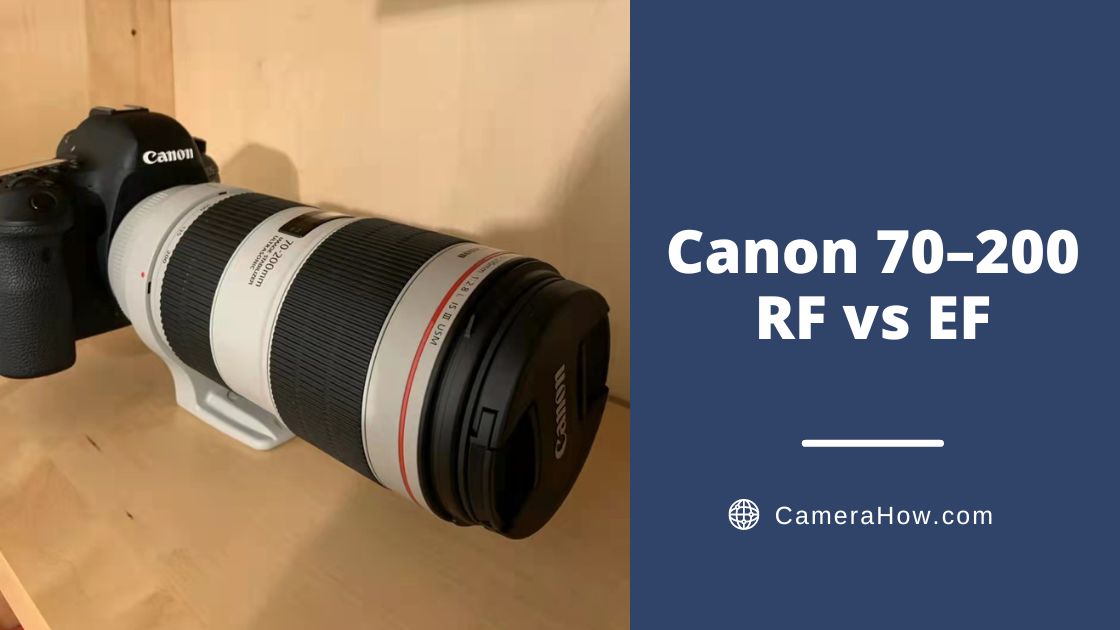
As a high-performance lens, Canon 70-200 2.8L IS USM lens is popular among many photographers for its professional build quality, premium picture quality, and useful focal length range. Canon also continued to upgrade and improve this lens over the years. And today, I’m going to show you the main difference between the Canon 70-200 F2.8L IS RF and EF(III).
The most noteworthy difference between these two lenses is the weight and size. The Canon 70-200 RF is almost 1/3 lighter than EF. And the smaller dimensions make RF fit your bag better. But the main disadvantage of the RF version is the incompatibility with extenders (teleconverters).
Here’s the comparison table:
| Version | Weight | Dimensions | Min Focus Distance | Extender Compatibility | System Compatibility |
|---|---|---|---|---|---|
| RF | 2.35 lb | 3.54 x 5.75″ | 2.3′ | No | R System Mirrorless Only |
| EF(III) | 3.26 lb | 3.5 x 7.83″ | 3.94′ | Yes | DSLR or Mirrorless via adapter |
What’s the Difference Between Canon 70–200 Rf and Ef?

Weight
As a high-performance lens, Canon 70-200 EF weighs 3.26lb(1480g), which is not easy for long time use. However, the Canon 70-200 RF only weighs 2.35lb(1070g). About 400g of weight will be removed from your shoulder for each shooting trip.
Size
Canon 70-200 EF is sometimes too long to be portable, especially with the EF-RF adapter. Relatively, Canon 70-200 RF has a shorter length and a slightly bigger girth. But overall, it’s still significantly smaller than EF, making it easier to pack it in your bag.
Focus Design
As a tradeoff for its size, Canon 70-200 RF is no longer internally zooming, it will extend when you zoom.
Min Focus Distance
The minimum focus distance of the RF version is shorter than the EF (3.94 ft compared to 2.3 ft). This is also a great advantage; you can get shots that the EF version cannot.
Extender Compatibility
The worst drawback of the RF version is that it no longer supports teleconverters. If you choose the RF version, you may have to give up the flexibility of those teleconverters.
System Compatibility
The generic difference between RF and EF is that the RF mount is only compatible with R system mirrorless models. The EF mount can fit both DSLR and mirrorless, but it needs an adapter for mirrorless.
If you’re comparing options, this guide on using DSLR lenses on mirrorless cameras may help clarify adapter compatibility.
Price
As an upgraded version of EF, the RF version costs hundreds of bucks more. But you can get nearly the same performance with the EF version on a lower budget.
Conclusion
Choose the RF version if you want more portability and save more room in your bag. But if you enjoy the flexibility of extenders and want the same performance with a lower budget, then the EF version will be a better choice.