
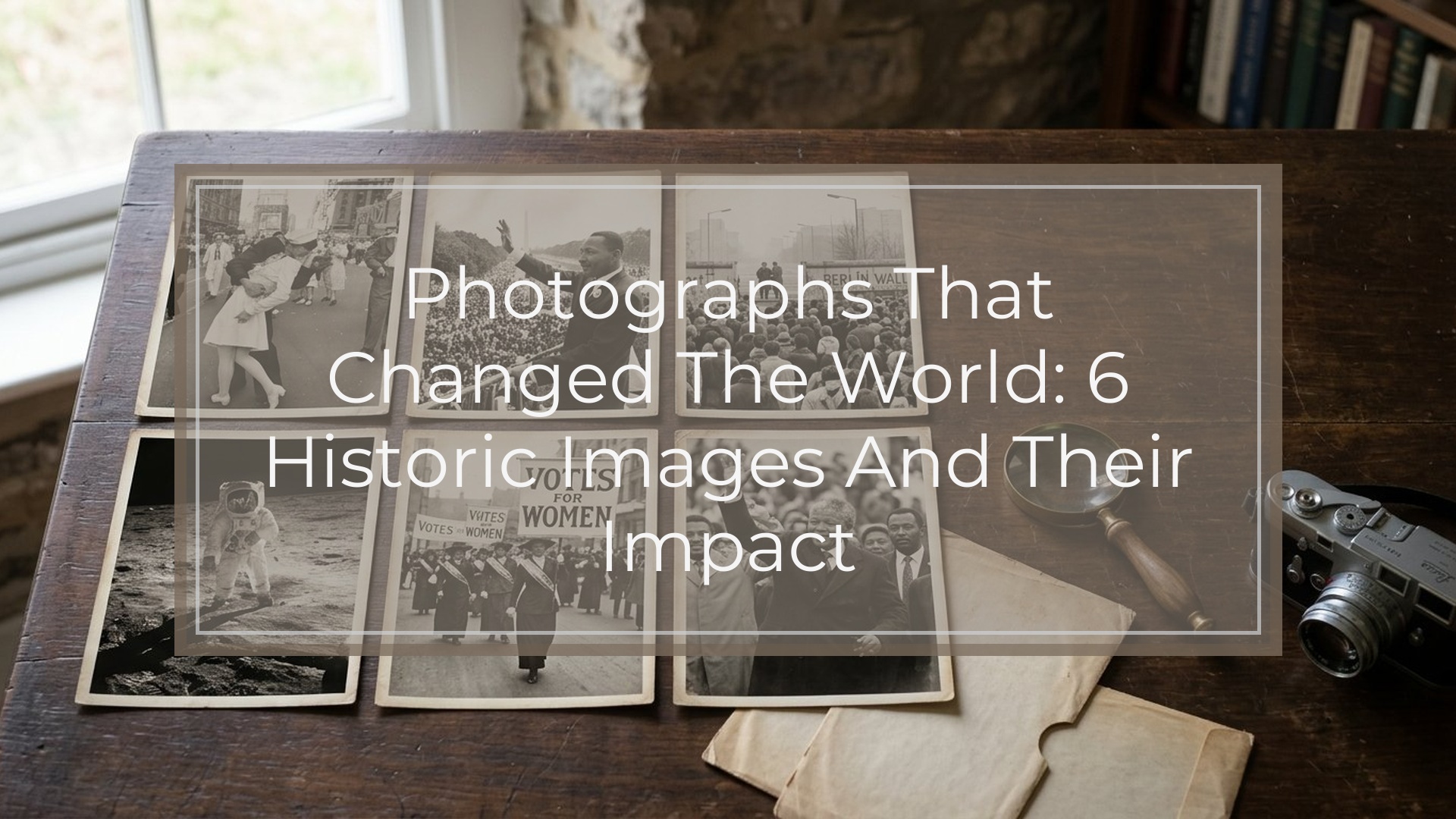
Some photographs do more than document a moment. They change how people think, what they care about, and sometimes what nations do next. A world-changing photograph usually combines three things: timing, emotional clarity, and wide circulation. It captures something larger than itself.
The images below are not just famous pictures. They helped define photography as a medium, shaped public memory, influenced debate about war and poverty, and even changed how humanity sees Earth itself. To make the list useful for beginners, this article first explains what makes an image historically influential, then gives a quick-scan summary, then walks through nine landmark photographs in a clear timeline from early photo history to the digital era.
How a Photograph Changes the World
A photograph changes the world when it moves beyond private viewing and becomes part of public life. That influence usually happens in one of four ways.
First, a photo can introduce a new way of seeing, as the earliest photographs did. Second, it can make a distant issue feel personal, which is why documentary and war images often matter so much. Third, it can turn into a symbol, standing for a nation, movement, or tragedy long after the original event. Fourth, it can spread at exactly the right moment, reaching newspapers, television, or social media when people are ready to react.
So the real question is not only, “Is this a strong image?” It is also, “Did this image change public memory, conversation, or behavior?” The photographs below did.
Quick List of Photographs That Changed the World
| Photograph | Photographer | Date | Why it mattered |
|---|---|---|---|
| — | — | —: | — |
| View from the Window at Le Gras | Nicéphore Niépce | c. 1826/27 | Proved photography itself was possible |
| Migrant Mother | Dorothea Lange | 1936 | Humanized the Great Depression |
| Raising the Flag on Iwo Jima | Joe Rosenthal | 1945 | Became a lasting symbol of wartime sacrifice |
| Gandhi at the spinning wheel | Margaret Bourke-White | 1946 | Condensed a political philosophy into one portrait |
| Earthrise | William Anders / Apollo 8 crew | 1968 | Shifted global perspective toward Earth and environment |
| Tank Man | Jeff Widener and others | 1989 | Embodied individual resistance to state power |
| The Terror of War (Napalm Girl) | Nick Ut | 1972 | Brought war’s civilian cost into public view |
| The Falling Man | Richard Drew | 2001 | Became a difficult but essential image of 9/11 |
| Aylan Kurdi on the shoreline | Nilüfer Demir | 2015 | Accelerated global debate on the refugee crisis |
1. View from the Window at Le Gras — the First Surviving Photograph
What it shows is simple: a view from Nicéphore Niépce’s estate in France. But historically, it marks a turning point. Made in the 1820s using a long exposure on a pewter plate, it is widely recognized as the first surviving photograph.
Why did it matter? Because it changed the world before mass audiences ever saw it. It proved that light itself could make a lasting image without a painter’s hand. Every camera, phone image, and news photograph that came later traces back to this breakthrough.
Practical takeaway: influence does not always begin with drama. Sometimes the most important image is the one that makes a new medium possible.
2. Migrant Mother — Photography as a Human Face of Economic Crisis
Dorothea Lange’s 1936 photograph shows Florence Owens Thompson with children pressed close to her during the Great Depression. The composition is intimate and direct: a worried mother, hidden faces, no distractions.
Its power came from timing and humanity. Millions already knew the economy was broken, but statistics do not create empathy the way a face does. The image became a defining symbol of rural poverty in America and helped strengthen public awareness of relief needs.
It also established a core truth of documentary photography: one carefully framed portrait can stand for an entire social crisis.
Practical takeaway: if you want viewers to care about a big issue, show the human experience inside it.
3. Raising the Flag on Iwo Jima — a Symbol That Outgrew the Moment
Joe Rosenthal’s 1945 image captures U.S. Marines raising the American flag on Mount Suribachi during the Battle of Iwo Jima. The photograph is full of motion, diagonal energy, and teamwork rather than individual heroics.
Its influence came from what happened after the shutter clicked. Published during World War II, it quickly became a national symbol of determination and sacrifice. It was reproduced everywhere, used in war bond drives, and later inspired the Marine Corps War Memorial.
The photograph helped shape wartime memory more than it explained the battle itself. That is often how symbolic images work: they compress a huge event into one unforgettable visual.
Practical takeaway: strong shapes and clear group action can turn a moment into an enduring symbol.
4. Gandhi at the Spinning Wheel — an Image of Political Philosophy
Margaret Bourke-White’s portrait of Mahatma Gandhi at his spinning wheel is quieter than many famous historical photographs, yet its influence is enormous. Gandhi is not shown giving a speech or leading a march. He is reading beside the charkha, the hand-spinning wheel tied to self-reliance and resistance to British industrial control.
That symbolism is the reason the image mattered. It translated a political philosophy into a visual form almost anyone could understand: simplicity, discipline, and independence.
The photograph shows that influence does not require spectacle. Sometimes a still portrait carries power because every object in the frame reinforces the subject’s ideas.
Practical takeaway: meaningful context inside the frame can make a portrait far more powerful than expression alone.
5. Earthrise — Changing How Humanity Sees the Planet
Taken during Apollo 8 in 1968, Earthrise shows Earth appearing above the lunar horizon. The image is visually stunning, but its historical effect came from perspective. For one of the first times, people saw the whole planet not as endless territory but as a small, fragile sphere suspended in darkness.
That shift mattered deeply in the late 1960s and early 1970s, when environmental consciousness was growing. Earthrise helped give that movement a shared visual language. It encouraged people to think in planetary terms rather than national ones.
Unlike crisis photography, its power came from awe. It did not shock viewers; it repositioned them.
Practical takeaway: a photograph can change minds simply by showing a familiar subject from an unfamiliar, revealing viewpoint.
6. Tank Man — One Frame of Individual Resistance
The image commonly called Tank Man was photographed in Beijing after the 1989 Tiananmen Square crackdown, with versions made by several photographers including Jeff Widener. It shows a lone man standing in front of a column of tanks, carrying shopping bags, blocking their path.
The frame is powerful because the visual idea is immediate: one person versus the machinery of the state. Viewers do not need detailed context to feel the imbalance and courage.
Its global circulation made it one of the defining protest images of the twentieth century. Even where political details blur, the symbol remains clear.
Practical takeaway: simplicity increases impact. When a photograph reduces a conflict to one unmistakable visual contrast, it becomes easier to remember and share.
7. the Terror of War (Napalm Girl) — an Image That Reshaped Views of War
Nick Ut’s 1972 photograph, often called Napalm Girl, shows children fleeing a napalm attack in South Vietnam. At the center is Phan Thị Kim Phúc, naked and screaming in pain. The road, soldiers, and smoke behind her make the scene impossible to soften or misread.
This image mattered because it forced audiences, especially in the United States, to confront war not as strategy but as civilian suffering. It became one of the photographs most associated with changing public feeling about the Vietnam War.
Its influence also came from credibility. It was not an illustration or a slogan. It was visible evidence.
Practical takeaway: honesty often matters more than polish. Raw truth can carry more force than technically perfect beauty.
8. the Falling Man — a Defining Image of 9/11 and Public Memory
Richard Drew’s The Falling Man, made during the September 11 attacks in 2001, shows a person falling from the World Trade Center. It is one of the most controversial famous photographs because many viewers found it unbearable.
That discomfort is exactly why it matters. The image resists abstraction. Instead of presenting 9/11 only through smoke, skyline, and collapse, it records an individual human reality inside the catastrophe. It became a necessary, if painful, part of public memory.
Not every world-changing photograph is widely embraced. Some endure because they force a society to face what it would rather avoid.
Practical takeaway: difficult images can be historically important when they preserve truth with dignity and restraint.
9. Aylan Kurdi on the Shoreline — the Speed of Modern Visual Influence
In 2015, photographer Nilüfer Demir made the image of Aylan Kurdi, a young Syrian boy whose body washed up on a Turkish shoreline after a failed sea crossing. The scene is stark, quiet, and devastating.
The photograph spread globally at digital speed. Within hours, it was central to discussions about the refugee crisis, borders, and humanitarian responsibility. Many people who had followed the crisis only in headlines suddenly responded emotionally to a single, specific life lost.
Its importance shows how modern influence works: not just through newspapers or archives, but through immediate online circulation across countries and languages.
Practical takeaway: in the digital era, one image can still break through information overload if it is clear, human, and impossible to ignore.
What These Photographs Have in Common
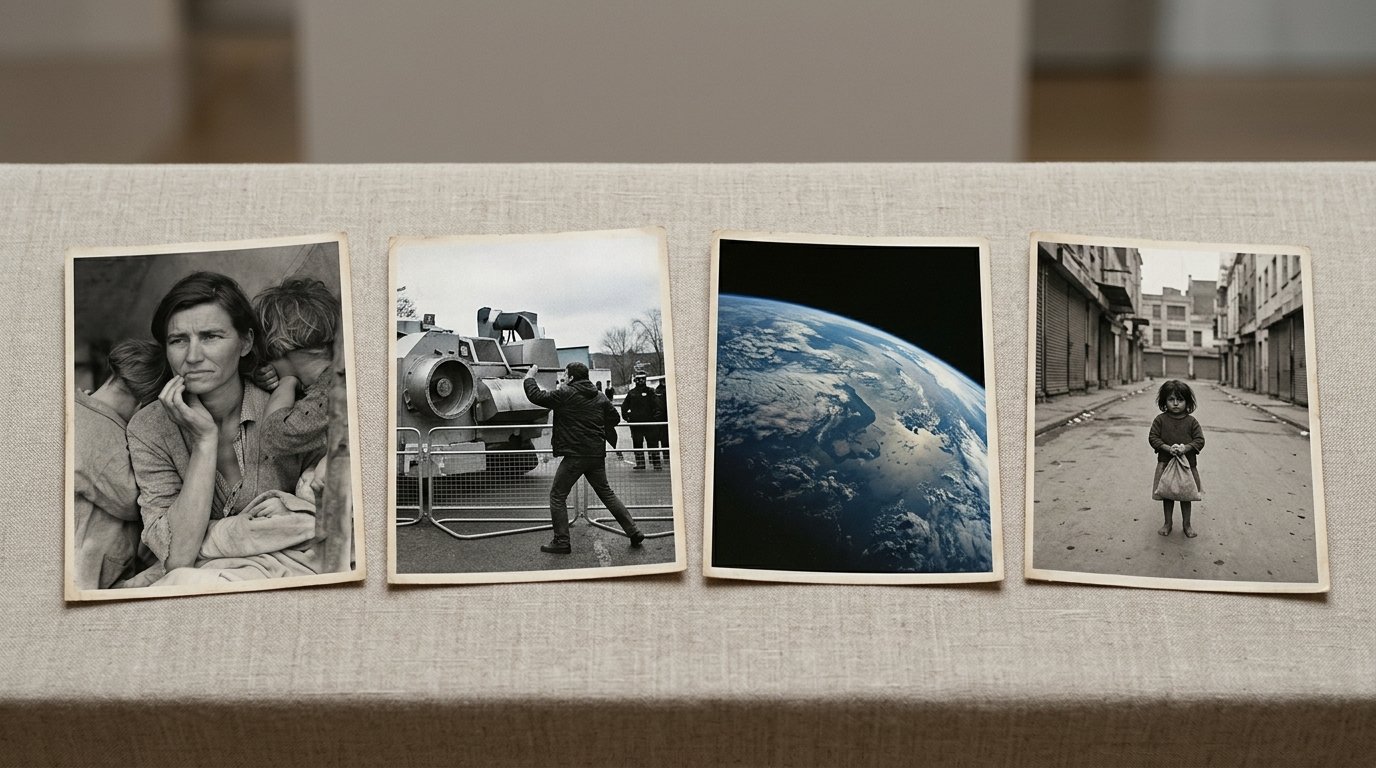
These images differ in subject, style, and era, but their influence follows the same pattern. Each gives viewers a clear visual idea very quickly. A mother in hardship. A man against tanks. Earth from space. A child as the cost of war or displacement. Confusion is not what made them powerful.
They also connect the individual to the collective. Even when one person appears in the frame, the picture points to something larger: poverty, protest, nationalism, environmental awareness, terrorism, migration.
Another common thread is distribution. A strong photograph does not change the world in isolation. It needs circulation through prints, magazines, newspapers, television, museums, or social media.
Finally, these photographs last because they shape memory, not just news. They become the image people think of when they think of a historical event or idea.
What Photographers Can Learn from History’s Most Influential Images

Most photographers will never make a globally famous image, and that is not the real lesson here. The useful lesson is that lasting photographs usually do a few basic things extremely well.
First, they are clear. The viewer understands the subject fast. Second, they have emotional direction. They make the viewer feel something specific: empathy, awe, grief, tension, admiration. Third, they include context without clutter, so the frame says more than the subject alone. Fourth, they arrive at the right moment, whether that means timing the action or publishing when people are paying attention.
For beginners, this is encouraging. You do not need exotic gear to practice these skills. You can study gesture, symbolism, framing, timing, and storytelling in everyday scenes. History’s most influential images remind us that photography matters most when it helps people see more clearly.
FAQ
What Is the Most Famous Photograph That Changed the World?
There is no single universal answer, but Migrant Mother, Earthrise, Tank Man, and Raising the Flag on Iwo Jima are among the strongest candidates. Each became bigger than its original moment and shaped how millions of people understood an event or idea.
Why Do Some Photographs Become Iconic While Others Are Forgotten?
Iconic photographs usually combine strong composition, emotional clarity, historical timing, and wide circulation. They also stand for something larger than the specific scene. Many good photos are forgotten because they lack distribution, symbolic power, or a connection to a major public moment.
Are World-changing Photographs Always Photojournalism?
No. Many are documentary or news images, but not all. View from the Window at Le Gras changed the world by proving photography was possible, and Gandhi at the spinning wheel became influential through symbolism. Scientific, portrait, and space photography can also reshape public understanding.
Can One Photograph Really Influence Politics or Public Opinion?
Yes, though usually as part of a bigger conversation. A photograph rarely changes policy by itself, but it can accelerate attention, humanize abstract issues, and become a rallying point. Images like Napalm Girl and Aylan Kurdi’s shoreline photograph show how visual evidence can move debate quickly.